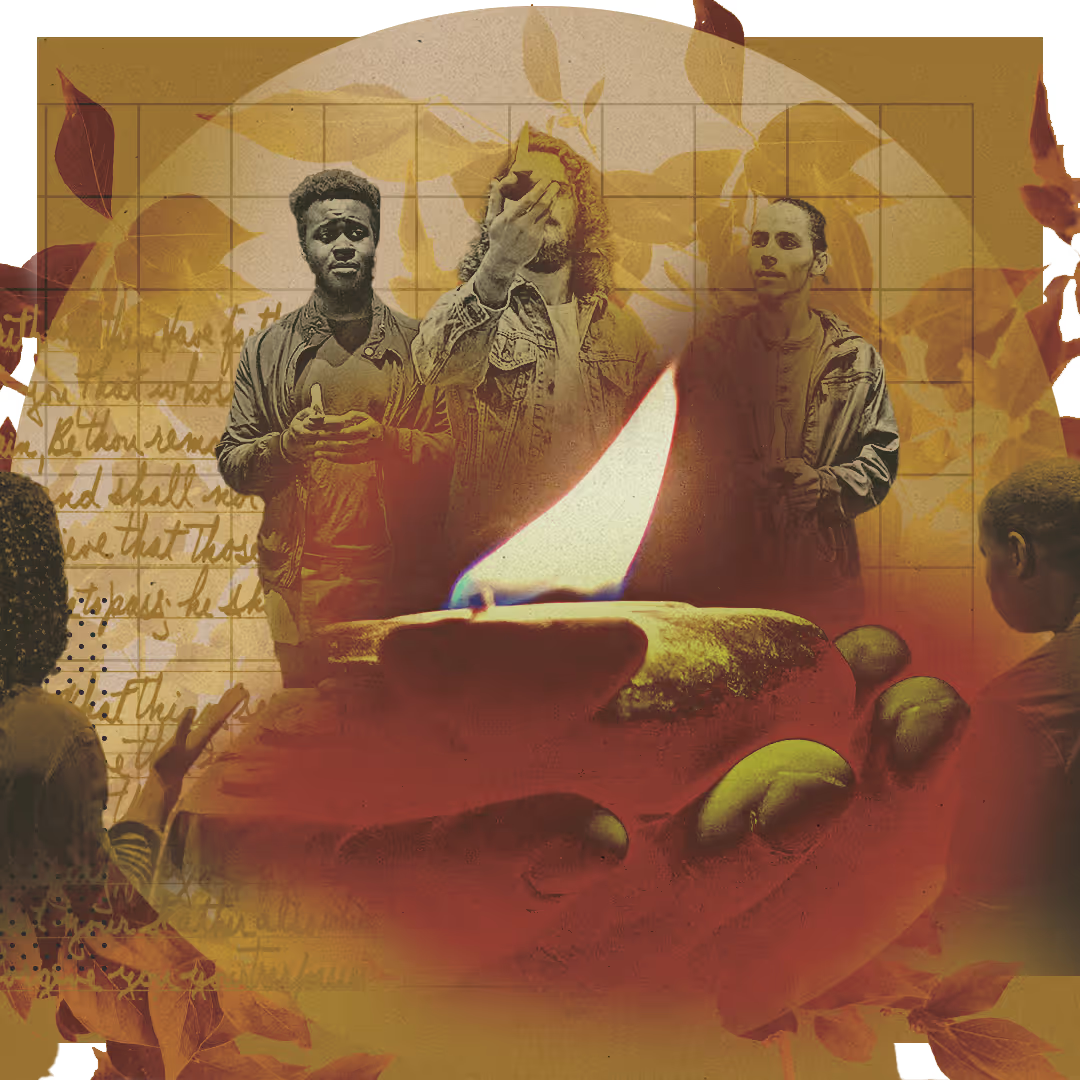
David: [upbeat music] This is the story. Acts doesn't start a new story. It just- as it's everything that Jesus began to do, it's everything God's begun to do ever since the beginning, and that we can't lose sight of Genesis and the story of God is going to build a kingdom on Earth.
Christine: [upbeat music] Welcome to the Spoken Gospel podcast. Spoken Gospel is a ministry that's dedicated to speaking the gospel out of every corner of Scripture. In Luke 24, Jesus told His disciples that every part of the Bible is about Him. In each episode, hosts David and Seth work through a passage of Scripture to see how it's all about Jesus and His good news. Let's jump in. [upbeat music]
David: Well, welcome, everyone, to the Spoken Gospel podcast. We have a very special episode today because I have two people to introduce you to, and I'm very excited for you to get to know them as we dive into the book of Acts. Seth right now has been traveling. We haven't been able to sync up our schedules to get him in here to have this conversation, and I thought, "What a better opportunity to sit down, study the book of Acts with two of my favorite people to study the Bible with?" So I have here with me someone you might have heard about in the background for a long time. You maybe- you've heard her referenced as she sat with Seth and I in the podcast studio, helping fact-check us and breathe into it. She has been studying the Bible with us for years now, but this is Christine Kozar. Christine, can you say hi to everyone?
Christine: Hello.
David: [chuckles] There she is, and she's excited to be here, and, and I also have Josh Lechica here with me, who's our director of marketing.
Josh: That's right.
David: Yeah, but he is one of our favorite people for me and Christine to sit down with and study the Bible together because he asks such good questions, because he's not as burdeningly nerdy as we are, and [chuckles]...
Josh: I wish I was as nerdy as you guys. That would be awesome.
David: Well, you're, you're on, you're on your way. [chuckles]
Josh: Okay.
David: I don't know if that's a good thing or not-
Josh: Okay, good
David: ... but you're on your, you're on your way.
Josh: Okay.
David: And so I'm excited for him to help us, uh, kinda stay on track, ask good questions, and make sure we don't get too lost in the weeds. So I'm really excited about this format here as we're gonna dive into the book of Acts. When we think about the book of Acts, like, what comes to our minds? I think for me, uh, when I was originally reading it, it's like a... I think for me it was like a, a grouping of loose stories about the early Church, and I, I think that might be, like, the simplest way to put it for me. But in the worst light, I think I saw it as maybe like a doctrinal statement on how to walk through the steps of salvation and what your church should look like.
Christine: We had very different experiences. [chuckles]
David: What was your experience, Christine?
Christine: It has been my favorite book for a very long time. It's a book I've come to to get refreshed, to be encouraged, to be inspired. There's so many characters in Acts, and they're all so different, and the way that the same God uses His Spirit to empower them and do His work in the world was always encouraging to me 'cause everyone is so different in it, and they go on so many adventures. [chuckles] So I've loved Acts for a long time. I've really enjoyed it-
David: Yeah
Christine: ... studying for this podcast, too.
Josh: Yeah, I'd say for me, my experience was probably pretty similar to yours, David, in that, you know, when thinking about Acts, it's kind of this doctrinal book of like, "Okay, how, how did the early Church act? What are the things that they did? And then let's do that today."
David: Right.
Josh: Um, and that's primarily what has, it has been about for me-
David: Yeah
Josh: ... as well.
David: It's been the- there's been these two kind of battlegrounds inside the book of Acts, like, that I've been used to seeing. One is, "What's the formula for salvation?" You know, in what order is there repentance, belief, baptism, laying on of hands, the filling of the Holy Spirit? And Acts kind of, as I've been reading it, you know, again and again and again, defies that kind of taxonomy because it's- it just keeps jumping around the order and what elements are present and in which way and by whom. And so I'm like, "Well, I don't think that's what it's trying to do."
Josh: Well, and Luke probably wasn't concerned about something like that to begin with, right?
David: Yeah, that's a good question. I don't, I don't think so. I think i- we- we're told at the beginning of his, of his book, letter... What do we call this thing? What's a good w- what's a good word? It's, it's not a book in the way we would think about it. It's not an epistle or a letter like Paul wrote. It's... Is it a-
Christine: It's-
David: He's writing it to Theophilus.
Christine: It's an orderly account according to Luke-
David: Oh, I like that
Christine: ... 1.
David: Orderly account.
Christine: So according to all the things he's investigated by eyewitnesses and servants of the Word, so that's right at the prologue of Luke 1, where he first introduces his work of the Gospel. And so it just shows
Christine: a doctor being very, very thorough in his research and wanting to do Theophilus a service to kind of consolidate all the things that Theophilus likely has heard and been taught. And Luke is saying, "I'm gonna write all this down for you, and I've done my homework. I've talked to the eyewitnesses. I've talked to the servants. I've..." In Acts, we'll see he's actually been on mission with Paul, and so there are some things that he has seen firsthand. So he's compiling all these things together in
Christine: a way that he is making certain points, but it's a service to Theophilus, who might have been his patron for the composition of two very big books that make up, that make Luke the one who wrote most of the New Testament. [chuckles] So-
David: From an order of words, like-
Christine: Yeah
David: ... that's crazy.
Christine: As far as word count, Luke wrote-... more in the New Testament than anyone else.
David: And so there's a couple- yeah, so there's a couple things in here that I wanna, I wanna talk about. One is, who is Luke? Who is Theophilus? And then I wanna get to Josh's kind of question, which was, what was he concerned about? Was he concerned about giving the order of salvation [chuckles] that- the steps we need to go through, or what was he- what occasioned the letter, I think is, is the question. So who is Luke? What do we know about him that's unique or, like, what, what's- you said doctor. Where do we get that idea?
Christine: He is- I forget which epistle it's in, but Paul calls Luke a doctor, and so- and that doesn't just mean, like, medical doctor. That would, at his time, meant a very high level of education in many different branches. So he was an artist, too, and possibly well-versed in music and stuff like that. And so him, one, being able to write and being a doctor and, yeah, all those kind of show that he's probably the most educated-
David: Yeah
Christine: ... Gospel writer, which would show in the Greek, but-
David: It, yeah
Christine: ... maybe less so in the English.
David: It does show in the Greek, yeah. I remember when I was studying Greek [chuckles] in college, it was like, "Don't even try to do Luke or Hebrews. Good luck," 'cause the Greek is just so dense and difficult and, uh, unique in, in those books. I think another reason why we'd be like, "Oh, Luke is a higher educated class, uh, of some kind," is simply because he did have a patron pay him to create these works. Which I- my guess is, if I was a patron, if I was Theophilus, and I wanted to pay someone to create an orderly account of Jesus and his disciples in the early church, and all that Jesus did, I probably wouldn't hire a fisherman. [chuckles]
Christine: He prob-
David: Jesus, Jesus would, but, but I, [chuckles] I probably wouldn't.
Christine: Well, you would need someone who could read and write to begin with.
David: That's right, yeah.
Christine: Yeah.
David: And so, okay, so Luke is this doctor, maybe not just meaning some kind of medical physician, but a highly educated individual who read, write, could give an orderly account. He's qualified for this task, and he wrote the Gospel according to Luke, and that was volume one of his orderly account to Theophilus. And then Acts is his volume two of his orderly account to Theophilus, where he is trying to tell Theophilus all that Jesus began to do in, in Luke, and then continues to do in Acts, and we'll get into that. So that's Luke. Anything else to say about Luke as an individual? Do we know if he's Jewish, Gentile?
Christine: I think he's a Gentile.
David: Yeah, I think so, too.
Christine: Which would also make him unique in the Gospel writers.
David: Right.
Christine: But I don't know his heritage exactly.
David: Yeah.
Christine: We first encounter him in Troas when Paul is on a, a mission trip. That's when the-
David: The language shifts to "we"
Christine: ... the language shifts to "we" from just narrative, and so we know that Luke joins there, but we don't know.
David: Mm.
Christine: I don't know. I'm sure there's more to look into there.
David: Yeah, it's interesting. So y- you do have this
David: firsthand account of some of the events, like in the second half of Acts, after he's- he joins Paul's crew in Troas. But you also have this unique feature where he's not a firsthand account of the things that Jesus did, uh, at least as far as we know. But he's gathering an orderly report, gathering all of these things and reporting on them in an, in an orderly way. I think the other fun thing about Luke, and this is so out there and nerdy that I just have to share it... It will add no value to anyone's life [chuckles] other than make- maybe making the end of Luke make a little bit more sense, and maybe not. But [chuckles] there is a genre of Greek literature of boating travel logs.
Christine: Yes!
David: Do you know about this?
Christine: Yes.
David: Yes! Oh, my gosh.
Christine: Not a lot, but-
David: Yeah
Christine: ... yeah, go on.
David: Yeah, it's fascinating. And so people just loved writing about their journeys on the high seas, and where they ported, and what the winds were doing, and what the waves were doing, and where they dropped anchor, and how long they dropped anchor, and it was a genre of literature. And so a lot of people think Luke was either very familiar with that genre or enjoyed it himself.
Josh: He went into so much depth.
David: I know! [laughs]
Josh: I was like, "Wow, is he a sailor or something?" Like... [chuckles]
David: I know. And so it's like, is he a sailor? Who knows? But because he's so widely educated, he's read and is familiar with this genre of literature of boating travel logs of the Greeks and is writing that, which would be very interesting to especially someone of a high class like Theophilus. Because, you know, who's writing about your travels on the boats and things like that? It's, it's people who have money and can travel and, or merchants or things like that. And so he's probably throwing Theophilus a literary bone there to be like, "Hey, you enjoy this kind of reading. Here's our travel log," which-
Christine: The Odyssey of Paul.
David: Yeah, [chuckles] right. And so it just- uh, that helps me make more sense of why he goes into so much weird detail. For me, it's weird about his, where they weighed anchor, and how long, and what the winds were doing. 'Cause I'm always thinking, "What's the theological [chuckles] significance of this?" And, uh, I'm sure there is some, but...
Christine: Well, and our Bibles likely have the shorter version of Luke and Acts, because there are two versions of Luke and Acts.
David: Mm-hmm.
Christine: And there's a shorter one and a longer one, and the longer one actually is about a third longer. It doesn't contain any new stories, but it elaborates more on the stories in, in the version that we have.
David: Oh, okay.
Christine: So nobody knows which one was written first, but it's likely that Luke wrote both of them, and one of them he edited either to be longer or shorter. But, for instance, with, like, the storm and the boat, it- he just adds more flourish and embellishes the stories and- [chuckles]
David: Do you know, like, uh, what, if, if, what traditions use the longer version of Acts in their scriptures, or does no one?
Christine: It's more in the... So the longer versions were translated into Slavonic primarily.
David: Okay.
Christine: And so it's more, more well-known in the East, but you can find both online, so.
David: Okay.
Christine: Yeah.
David: That's cool.
Christine: Yeah.
David: So that's Luke. Theophilus, we've gotten to a little bit.... he must have been a man of means of some sort. Theophilus is a Greek name.
Christine: It means lover of God.
David: It means lover of God. Okay, since it means lover of God, I think one of two things is probably happening here. Either there's this ironic reversal of his name because it would be lover of the gods, the, you know, the Greek pagan gods, which would probably be a common thing to name someone. Do you think there's also a chance that this is pseudepigraphal in a sense, where, like, maybe his patron didn't want to be named in the literature because of the persecution that was facing the church, and he's just calling him a different name? Uh, you know, "Hey, hey, lover of God," and gives him this Greek name. Uh, any thoughts on that?
Christine: It's possible. I haven't looked into that, but it also helps me kind of see myself in that name-
David: Mm
Christine: ... or anyone who opens Luke or Acts are likely opening it to learn more about God, and so it's like-
David: Hey, lover of God! [chuckles]
Christine: It's like Luke welcomes you on the first page-
David: Oh, that's awesome
Christine: ... and says, "I'm here to take you on a journey to-
David: That's beautiful
Christine: ... meet the God you're looking for."
David: I love that.
Josh: I love that.
David: Yeah. Oh, so next time you open the book of Acts, hopefully today, open it up and just let it say, "Hey, lover of God, [chuckles] here's a story for you."
Josh: That's awesome.
David: I love that. Okay, and so why, then, why would Theophilus, uh, commission such a work? And do we have any sense on what kind of work this is that he's commissioned, this orderly account? I, I mean, it's like he wants to know about Jesus. He maybe started following Jesus. Maybe he heard the good news through the missionary journeys of Paul and was like: "I wanna know more about what's going on, and maybe written more for me," especially if, if he even, even had access to
David: some kind of oral tradition around Mark's account or Matthew's account of the gospel. It had more of a Jewish bent, and he's this Greek and is probably wanting an orderly account that has more to do for him. Any other reasons why he would commission such an account? I didn't look into this, Christine, did you? Do you know about any other types of this kind of literary genre of a commissioned historical account from a patron to a worker to, like, create this? I have, I have to assume that's a genre of sorts.
Christine: It is, as far as most things written were commissioned-
David: Mm-hmm
Christine: ... because writing was very expensive-
David: Yeah
Christine: ... in this, in this time. Well, for the vast majority of human history, literate people were few and far between, and things that were written were, in a way, kind of immortalized or, like, kind of set with a timestamp, as it were. And so it was a way of preserving things of great importance, and so it would make sense that someone who loves God wants to have an account of the life of Jesus and, and His church. So I know that lots of, if not most things written at the time, were commissioned for preserving things like that-
David: Yeah
Christine: ... just because you couldn't just buy a-
David: Plop down and write.
Christine: Yeah, you couldn't just-
David: Open up your Word document. [chuckles]
Christine: ... get a Post-it note or something like that. All these things were extremely expensive, like the equivalent of thousands of dollars in our money. So-
David: Yeah
Christine: ... so it makes sense that it would be a contribution to, to the Church, and he would want to support something like that.
David: Yeah, so not only would it have been, and I don't mean this in a bad way, self-seeking, like, "I want this orderly account for myself," but he's probably wanting to commission and patron something that would benefit the whole Church, which it has [chuckles] immensely. Okay, that's Luke. That's Theophilus, and we've kind of gotten into this letter then or this orderly account, this two-volume orderly account of Luke/Acts. Luke being what Jesus began to do, which is how he opens his orderly account in Acts, and Acts being what he continues to do through his church. So that's actually where I want to start our conversation, is this idea of what he begins to do. So let me read the beginning of Acts chapter 1 here: "In the first book, Theophilus, lover of God, I wrote about all that Jesus began to do and teach until the day when He was taken up to heaven, after giving instructions through the Holy Spirit to the apostles whom He had chosen." So he has this idea of, "I've written an orderly account of all that Jesus began to do," but that begs a question. [chuckles] Why is this not all that Jesus did? Why is it what He began to do? Thoughts?
Josh: I mean, for me, it just reminds me of, like, Paul's conversion story-
David: Mm
Josh: ... when he's- when Jesus comes, He says, "Paul, why are you persecuting me?" But Paul is persecuting the Church, but Jesus identifies the Church as Himself, and so this idea that the Church is continuing to do the, I guess, acts of Christ, um, on Earth.
David: Yeah, I think it's a lot of that. I think it's even more than that, right? It's not only that he, he doesn't say, "Why are you persecuting my works or the activity of those who are doing things in my name?" It's, "Why are you persecuting me?" That there is this union that Jesus now has with His people so that Jesus is actually functioning in His church. And so it's not that in Luke, Jesus is doing things, and then in Acts, Jesus' followers are doing things. It's in Luke and Acts, Jesus is doing things, that it's His functioning, and we're gonna get into a lot of that, I think, as we talk about the idea of kingdom, as we talk about the idea of the Holy Spirit, and we explore some of those ideas. Christine, anything else to add to this idea of, why does he begin with what Jesus began to do and teach?
Christine: I, I think Josh said it really well. Began to do implies we're about to see the continuation of His works.
David: Mm-hmm.
Christine: So the agent of the Acts is kind of identified right at the beginning. It's Jesus doing works in the world, and-... we're gonna see that even though he ascends, which Luke records at the end of his gospel and at the beginning of Acts, it does show that Jesus is going to be working through his people and continuing to spread his kingdom in the world.
David: Yeah. There's an interesting- there's a few interesting things I wanna point out here about this continuation that happens. So we see it in Acts 1:1, where Jesus began to do in Luke and continues to do in Acts. We also see in 1:11, the, the report of what the angels said to the apostles after Jesus ascended into heaven on a cloud. He ascends to heaven on a cloud, which we need to talk about.
Christine: Yes, we do.
David: Um, but he says, "Why do you stand looking up toward heaven? This Jesus, who has been taken up from you into heaven, will come in the same way as you saw him go into heaven." Now, I think this- so he went up on a cloud, which means he's gonna come down on a cloud. We need to talk about what that means, but at the very basic level, I'm like,
David: this, this can mean at the end of time, like, when Jesus comes on a cloud and, and reveals himself from heaven, and the heavens and Earth are stripped away, as Revelation says, and we just behold him, and nothing stands between us. But there's also this picture we're gonna look at in depth in the next episode, in, in the Pentecost, where you have this wind and fire that comes into the upper room that would create smoke and, and clouds, and this kind of obfuscated vision. And is this a reference to what he's promising about the outpouring of the Spirit? Is Jesus was taken up in a cloud, and he's going to come in the cloud of his presence in the Holy Spirit? Because oftentimes in even the Old Testament, when God's presence fills a temple, what is it that fills it? A cloud. It's smoke, and it's a cloud, and I'm like, "Oh, that seems to be what he's promising." And so the reason I'm highlighting that is to say that this is emphasizing the continuation of Jesus' personal ministry in and through his church. Because he is taken up to heaven in a cloud and then brings heaven down to Earth in a cloud to continue working in and among his people. Anything to add to that? And then I do wanna talk about the cloud, but-
Josh: That's cool. I've just never thought about it that way before. Like, that's super interesting-
David: Mm
Josh: ... to me. And so, so basically, the idea that Jesus or the Holy Spirit falling in the upper room is kind of like this idea of Jesus coming back to be with his people through the Holy Spirit. So also kind of el- elevating the deity and the status of Jesus, and, like, identifying him as one with God and the, and the God the Father and the Holy Spirit, and-
David: Yeah, there's something crazily trinitarian-
Josh: It feels like there's a lot going on [chuckles] there.
David: Yeah.
Christine: Yeah, I was not expecting you to go there. That was really interesting, but listening to you talk made me think, "Oh yeah, when God appears, there's wind."
David: Mm.
Christine: You see that in the garden. There's the wind of the day, and that is God in the garden, and then God in the Old Testament, when he's guiding his people through the wilderness, he's... His presence is depicted as a cloud.
David: Right.
Christine: And so God and cloud are strongly associated in the Bible, and so- and I think there's a certain prophet we're about to [chuckles] jump into as well, where that is very strongly seen. But-
David: Yes
Christine: ... yeah, those, those are talking to each other in a new way now.
David: S- so before we got- dive into the prophet-
Christine: Okay
David: ... because we sh- we have to, there's a couple things I wanna set up. First, I, I do just wanna touch on why cloud imagery? Because ever since we started studying this for the past couple of weeks, I, I've been thinking about if somebody tried to make a, a film of this. I don't think there's a way to picture this that would not look so cheesy, of Jesus surfing on a cloud and flying up to heaven. I'm like, I don't think that's the picture. [chuckles]
Josh: Nope. Yeah, I picture, you know, in Mario Kart, like, when you're playing Mario Kart, they get in the little cloud-
David: The cloud picks you up
Josh: ... before the, yeah. Yep, exactly.
David: Lakitus.
Josh: Yeah. [laughing]
David: [laughing]
Josh: That's what comes to my head-
David: Yes
Josh: ... when I think about that.
David: And you, like, you float on this little cloud. But like, I don't think that's what's being talked about here. So any ideas or, or thoughts around why is he talked about as a cloud rider or taken up in a cloud? What does that even mean?
Christine: Well, he is the God who thunders, 'cause thunder comes from clouds. And it's not just Israel that worshiped cloud-riding deities. There are other deities that claim to be the cloud rider because clouds brought thunder, which brought rain, which brought life, and so there is a whole association with
Christine: life and rain and the earth being blessed by the mover of clouds, and yeah, that's kind of-
David: Yeah
Christine: ... where, where my mind goes, but-
David: We're not meant to picture a human being surfing on the top of a cloud and flying up into the sky.
Christine: I imagine a chariot cloud, but [laughing]-
David: Oh, yeah
Christine: ... [chuckles] maybe, maybe that's off.
David: Well, I mean, there is an, uh, well, 'cause is this talking about Elijah?
Christine: No, but there's wind and fire there, too.
David: There's wind and fire.
Christine: I- That's, I mean... Well, yes, now. [chuckles]
David: Yeah.
Christine: But [laughing]-
David: 'Cause that's another time-
Christine: There's so many pictures
David: ... someone gets taken up into heaven.
Christine: Yes.
David: Right? And isn't there a chariot-
Christine: Mm-hmm
David: ... talked about?
Christine: Yeah.
David: Are there clouds talked about?
Christine: If we look at Elijah's ascension in 2 Kings 2:11, it says, "As they," this is Elijah and Elisha, "were walking along and talking together, suddenly a chariot of fire and horses of fire appeared and separated the two of them, and Elijah went up to heaven in a whirlwind."
David: Hmm. And when we hear about fire from heaven, we're supposed to think lightning.
Christine: Yes, that is-
David: Not-
Christine: ... generally-
David: Yes
Christine: ... fire from heaven is lightning.
David: Yeah, not like flames.
Christine: Yes.
David: Yeah.
Christine: Yes, which is when the-... similar when Elijah-
David: Yes
Christine: -prays on Mount Carmel, and God answers with fire. You need to imagine, like, lightning zapping Leon. [chuckles]
David: Yes, not a-
Christine: And incinerating-
David: -swirling cyclone of flames.
Christine: Uh, yeah, no.
David: Which is what I always thought.
Christine: Ooh.
Josh: That's- yeah, so why do they describe it as fire?
David: That's how they talked about lightning. We call it lightning-
Josh: Fascinating.
David: -they called it fire from heaven. [chuckles]
Josh: Okay.
David: 'Cause that's-
Christine: That's what it is
David: ... kind of what it is. [chuckles]
Josh: Yeah.
David: Yes.
Josh: No, it makes sense.
David: Yeah, I know.
Josh: Yeah.
David: It's crazy, though, isn't it? Yeah.
Christine: Burning bolts of electricity coming your way. [chuckles]
Josh: I mean-
Christine: It's gonna burn you.
Josh: It's hot, so-
David: Yeah
Josh: ... makes sense.
David: It's very- and it creates-
Christine: Yeah
David: -fire when it strikes things-
Josh: Right
David: ... that are flammable. So-
Christine: Yes
David: ... it makes a lot of sense.
Christine: And, and that also informed the- their picture of the cloud rider or the storm god. He would thunder from heaven, from the clouds, and he would throw lightning on Earth, and you would not wanna be in his way when he was mad. So that's the pagan understanding-
David: That's the pagan understanding
Christine: ... of what a cloud rider would do, and the Bible is all about upending that and saying, "No, the- these things you attribute to
Christine: pagan deities are true of God, the real cloud rider."
David: Yeah, and when He comes and shows you His thunder and lightning, good things happen, [chuckles] like, w- for His people. And we're gonna see the thunder and lightning, the tongues of fire, I should say, and the smoke and wind that fill the upper room. Now, you have the thunder and the lightning coming into the upper room. The cloud rider comes into the upper room in Pentecost, and the people are transformed, not destroyed.
Josh: It's interesting, too, because it- the idea of, like, a cloud-riding god in a pagan context just makes a, that kind of deity sound really distant from the people-
David: Mm
Josh: ... of like a, like in another place. Whereas, you know, looking at Acts in the upper room, it's like God comes down in the cloud to us and fills us with His Spirit-
David: Yeah
Josh: ... and transforms us and, like, is with us and lives with us, which is just a very different story that, uh, is being told.
David: I think to double-click on that, it makes me think of you've got this idea of a cloud coming down, and coming up, and coming down, and Jesus is, you know, the one who rises up and then sends His Spirit to come down and continue to dwell in His people. It's this picture of heaven coming to Earth, and Earth coming to heaven, and that's been the, the hope of the Bible since the beginning, is that you had this Garden of Eden, this temple mount where God and man could dwell together, where heaven and Earth overlapped. And here in the cloud riding Jesus, we have a human man of Galilee, and He calls them men of Galilee. You know, this human man of Nazareth, of Bethlehem, um, of Israel, who goes into the heavens in the clouds, the literal heavens, and now Earth is in heaven. And then He brings heaven to Earth in the Pentecost-
Josh: Ah, that's so good
David: ... and it's just a beautiful thing.
Christine: Well, and it's seen right here in 10 through 12 of chapter 1, 'cause the people talking, addressing the men of Galilee, are angels.
David: Yeah, heaven coming to Earth.
Christine: So heaven is on Earth.
David: Yeah. [chuckles]
Christine: There are literal angels among the crowd that are staring up at the sky, like, "Why are you looking for heaven?" [chuckles]
David: Oh, it's so good.
Christine: We're at heaven.
David: Yeah, why are you- yeah, why are you looking up at heaven? It's gonna be right here, and it is right here. Yeah, that's really cool. Okay, we've, we've teed it up enough. We have to go to Daniel 7 and talk about the maybe highest point where we get this vision of a cloud rider, and probably the main referent that Jesus, and, and Luke, and the angels are all making here, and why we're talking about the cloud rider. And so Daniel is in exile in Babylon, and he receives a vision from God, and it's- I think, uh, like, correct me if I'm wrong on this, but I'm like, I think the way to talk about this vision is it's, it's showing the rise and fall of beastly empires of the world. That these beastly empires rise out of this chaotic sea, this place of chaos and evil, and they come, and they rule and reign on the, uh, on the world, um, as these evil human empires. But then, the Ancient of Days comes from heaven, who is God, and one like a Son of Man, one like a human being, riding on a cloud, comes and subdues all of these nations and then sets up thrones for His people to rule over these nations. And h- His people end up taking these thrones because the cloud rider has conquered the evil empires. That's, like, my high-level overview. Like, walk through that again and ask some questions 'cause I'm like, I just zipped through one of the most confusing passages in the Bible, probably. [chuckles] So is that how you kinda see it, Christine, is how I summed it up, or is there a nuance there?
Christine: Well, we were only recently studying Revelation together, and John seems to love all that imagery-
David: [chuckles]
Christine: ... of throne usurpation, replacement, and things like that. And so- and we see all that in Daniel 7, the fact that if L- Luke is, in fact, cluing us into this image of Daniel 7, then we wouldn't only be reminded of, oh, the Son of Man riding on the clouds that is right there with God. We also know that that ascension, that enthronement, comes right before the saints receiving the kingdom-
David: Yeah
Christine: ... and ruling with God. So that's-
David: Taking their thrones.
Christine: Yeah. Yeah, and we see that in, like, Daniel 7:18: "But the saints of the Most High will receive the kingdom and will possess it forever, yes, forever and ever." And later in 27: "Then the sovereignty, power, and greatness of the kingdoms under the whole heaven will be handed over to the saints, the people of the Most High. His kingdom will be an everlasting kingdom, and all rulers will worship and obey Him," which seems to be a prologue fitting for Luke and Acts-
David: Yeah. [chuckles]
Christine: ... 'cause Jesus is ascended and is about to give and share His authority.... with his people.
David: Yeah. Okay, I'm hearing three things that I want to highlight, 'cause it seems to be like this is what's on the line in Acts, and in what did Jesus accomplish when He came to Earth, whenever He r- you know, did His ministry, when He died, when He rose, when He ascended, when He sent His Spirit? What's being accomplished? I'm hearing in the Daniel story, there's this defeat of evil kingdoms
David: by this cloud-riding God. There is the establishment of an eternal kingdom that will take the place of these evil kingdoms around the world, and that is all done, in the third point, through partnership with His people, who rule and reign on the thrones that God has dispossessed and given over to them. Is that- I'm feeling like those are three pillars.
Christine: That sounds like Genesis. That sounds like Joshua to me.
David: Mm-hmm.
Christine: That sounds like the story that God has been painting from the beginning, so it doesn't seem out of line.
David: No.
Christine: But you keep pushing, like, "Is this right?" Or-
David: I think-
Christine: I'm curious
David: ... I'm just trying to get clarity, like, how can we define these three ideas, or if that's even the right way to talk about it, really clearly so that we can see it in Acts? So you mentioned Genesis and Joshua. I actually think we should think about that for a second. So where are those elements that we just talked about in Genesis and Joshua? Maybe walk us through that.
Christine: Well, in Genesis, at the beginning, God creates a world and invites the humans He created to join Him in ruling it and filling it with life, and to rule over the fish of the sea, and the birds, and the beasts, and all of that. So there's this commission of man to rule alongside God over the beasts and master them, and that is kind of upended with the serpent driving humanity out. Like, they listen to a serpent instead of telling the serpent where to go. [chuckles] And here in Daniel, we see all these beasts are terrorizing the world and kind of oppressing humanity, and these beasts are s- you know, symbolic of different powers and kingdoms. But there's always this initial plan that we see in Genesis, that God's goal for humanity is to rule alongside Him and be like Him, and so that's the commission in Genesis. And God promises that to Abraham, that, "Nevertheless, your offspring will possess the gate of his enemies. Your, your offspring will be like the stars in the sky." And then we see in Joshua, when we have many children of Abraham who are commissioned to go out and subdue the, the monstrous powers that are terrorizing the land of Canaan. So it seems like God's plan hasn't changed.
David: Yeah. [chuckles]
Christine: We see similar patterns as the story of the Bible unfolds-
David: Yeah
Christine: ... and so here we are in Daniel.
David: Yeah, I think I just wanted to double-click on that, and thank you f- I think that's super awesome because this is the story. Acts doesn't start a new story. It just as it's everything that Jesus began to do, it's everything God's begun to do ever since the beginning, and that we can't lose sight of Genesis and the story of God is going to build a kingdom on Earth. And by that, what we mean is a, a place where His rule and reign creates a just and righteous, equitable place on Earth, where there's peace and shalom for God and man to live together and spread His image, and goodness, and glory to all creation. Like, that's His kingdom. It's this beautiful place. It's, you know-
Christine: That's right
David: ... prototyp- prototyped in the garden.
Christine: Heaven and Earth overlap.
David: Yeah.
Christine: You're with God, you're with angels, you're with animals-
David: Yeah
Christine: ... and everything is in harmony.
David: But there's been this beastly overtaking with... We saw it with the serpent, and then we see it when they leave the Garden of Eden, and we see what's pursuing Cain, this beast-like monster called sin. And then those- that beast-like monster called sin becomes these beast-like, sinful empires that are ruling and oppressing the entire world, and now all people are under their power and being ruled and reigned by them. And Daniel gives us this picture of a cloud-riding son of man, son of God, someone who is God, but looks like a man. [chuckles] And He is both, 100%.
Christine: The image of God.
David: He is the image of God. He comes, and He subdues all these enemies and conquers them, and by Him doing that, human beings that are a part of this Kingdom of God get to join Him in that rule and reign, like Adam and Eve were meant to do, and like Joshua went to do whenever he went to go clear out the Promised Land of the, uh, beastly rulers that were ruling it. And so it's just- I, I think this is so important to understand. What's on the line in Acts? It's just- it's not just the formation of a new religion, right? Which is, I think, how some people think about Christianity. It's not the formation of, "Oh, what should the Church look like in brick and mortar?" Or something like that. This is the story of the Garden of Eden and God's purpose for the cosmos coming into the world, and so when Jesus comes as the image of God on Earth, He does conquer all the beastly empires by not falling under any of their power or temptation, by taking on their strongest weapon of death, and then by triumphing over them, by rising from the dead, and then by being seated on the highest throne above every throne and putting all of them under His feet. And so what we're gonna see in the Book of Acts is, we're gonna see this kingdom proclamation that Jesus is King. He is the one who has risen from the dead, who is ascended on the highest throne, and as that kingdom proclamation goes out, what happens? What happens is, the beastly empires and the oppressive rulers of the world start to flee. Y- this is where you see demons running away and, and sickness and lame starting, starting to get healed, and you see m- magicians and sorcerers repenting and burning their spell books because they're being freed from these powers as the Kingdom of God goes around the world. So this is why I'm double-clicking on this.
Christine: It's good. It's exciting. It makes me want to jump in, 'cause it's kind of like you said, there's God and His people on the mountain, intended to reign, but then the monsters of the deep came and conquered.
David: Mm-hmm.
Christine: There, there's a conquest of God's mountain, and-... the rest of the story of the Bible is the reconquest or the counter-conquest, where the mountain conquers the deep.
David: Oh, that's good.
Christine: And so
Christine: God nevertheless shall reign and does reign, and nevertheless, His people shall reign with Him wherever the monster has dragged them down to. So the God of the mountain comes down and does the counter-conquest and reclaims His world, and that's kind of what people get to be a part of.
David: Yeah.
Christine: And-
Josh: So this is essentially, like, the crushing of the head of, the head of the snake-
David: Mm
Josh: ... in the Garden, right?
David: Yeah.
Josh: It's like-
David: Yeah, definitely
Josh: ... if it's connected to Genesis, and yes.
David: Yeah, what, what Jesus accomplished in His resurrection and ascension, the Church is now enacting in the, in their rule and reign on the Earth in the name of King Jesus.
Josh: And the spread of His kingdom.
David: And the spread of His kingdom.
Christine: Yes.
David: Taking territory from the beasts and from the serpent. Got it.
Christine: Because, again, Jesus and His church are indivisible, 'cause even with... It's the famous one that Paul quotes in Ephesians 5, but he says, like, "Oh, marriage is a mystery, but it's about Christ and the Church." We see, you know, Jesus associating Himself very intimately with the people that Paul is persecuting, and we see in Genesis 3, God promising that, "Your offspring will crush the head of the serpent," and Jesus is the one who does that. But then we see Paul telling people at the end of Romans, I think, that, "God will soon crush Satan underneath your feet"-
David: Mm
Christine: ... speaking to Christians. So it's, it's indivisible what Christ and His church do.
David: Ah, so good.
Christine: What Christ does, His Church does, 'cause He invites His people to reign with Him, so.
Josh: So that reminds me of something that, David, I've heard you talk about before, which is, you know, in the Garden of Eden, Adam and Eve, their mandate was to spread the borders of Eden-
David: Yeah
Josh: ... to fill the whole, the whole Earth. Um, obviously, then the Fall happened, and, um, they were exiled from the Garden. So in a way, is this like humanity, like, uh, through Christ being re-entered into the Garden, and now that Eden, like paradise, can now spread-
David: Yeah
Josh: ... uh, to cover and fill the entire Earth?
David: I got goosebumps.
Josh: Yeah.
David: You nailed it.
Josh: Okay. All right.
David: Yeah, that's-
Josh: Awesome
David: ... the picture is-
Christine: Yeah, 'cause we were transferred out of the dark kingdom, put into the kingdom of light. The counter-conquest [chuckles]-
David: Mm
Christine: ... of God reclaiming what's rightly His has happened, and now we join in re- helping, and we join God in reclaiming what is truly His.
David: Yeah, which makes sense then, having all this in their heads, and I don't know how much,
David: like, I don't know, counter-political ideas they had when they asked this question, but at the beginning of Acts, in verse six, the disciples are reported to come to Jesus before His ascension and say, "Lord, is this the time when you will restore the kingdom to Israel?" And He replied, "It is not for you to know the times or periods that the Father has set by His own authority, but you will receive power when the Holy Spirit has come upon you, and you will be my witnesses in Jerusalem, in all Judea and Samaria, and to the ends of the earth."
Josh: Oh.
David: And, and so we gotta talk about this, because this is-
Christine: Yes, we do
David: ... uh, what I like to call the table of contents of the Book of Acts. [chuckles] You have Jerusalem, Judea and Samaria, and the ends of the earth. This is like the table of contents, and the Book of Acts follows that structure. You have, uh, one to six, Jerusalem. You have seven is Judea, Samaria, and then eight and on, you have it going to the ends of the earth, and so it follows this pattern. But what, what is going from Jerusalem to Judea and Samaria and to the ends of the earth? It's this kingdom that they're asking about, and they seem to ask about it as, "Lord, is this the time that your kingdom will be restored to Israel?" And He seems to one-up them on the ante [chuckles] here, where He's like, "I'm, I'm not gonna have a local geography kingdom."
Josh: Right. Yeah, so there... Yeah, so I, I have a question about that-
David: Yeah
Josh: ... because I think I read that like, "When is the time you'll restore the kingdom to Israel?" And I think, "Oh, like, when will Jesus come back?"
David: Mm.
Josh: But that's not the question, because I have the benefit of hindsight, right? But that's not necessarily the question that they were asking.
David: I think it's a good question. What makes you connect the kingdom being restored to Israel with the second coming of Jesus?
Josh: It's a great question. [laughing] I'm actually not too sure.
David: Yeah. It's probably something that... It must be something that people just naturally think then.
Josh: Yeah.
David: And it's not totally wrong.
Christine: Yeah-
David: [chuckles]
Christine: ... I, I was thinking that myself-
David: Yeah
Christine: ... because Jesus doesn't correct their question-
David: Mm-mm
Christine: ... saying, "You're asking the wrong thing." It seems like their question is legitimate, that, "Okay, now that you are the Messiah, and you are here, and you conquered death, what is to keep, you know, the glory of God from filling the whole earth?"
David: Yes.
Christine: Like, it seems like they are associating Jesus's conquest of death as, "Okay, this is Heaven and Earth coming together. When is that gonna happen? And, you know, when is Israel gonna be this blessing to the nations that we see in the prophets, especially in Isaiah?" And Jesus is like, "Times and dates are not for you. There is actually something else, and there's this period of time that will be us on mission together to these different-
David: Mm
Christine: ... parts of the world." But yeah, that's how I've, like, seen it.
David: Yeah.
Christine: So-
David: So what I'm, what I'm hearing there is, uh, they are asking, "Okay, Jesus, you're the ascended king. When is the kingdom coming to Israel so that it might go to the ends of the earth?" We can give them the benefit of the doubt there, a- and I think we might think of that, some, some Christians might think of that as purely, $5 word, eschatological, purely about the end times-
Josh: Mm
David: ... when the Kingdom of Heaven comes to Earth, you know, Revelation 21, new heavens, new earth. But I think what we're seeing is Jesus links the coming of His kingdom in power to start in Israel and spread to the ends of the earth with the coming of His Holy Spirit, which is why He says, "You're gonna receive power on high when the Holy Spirit comes upon you, and then you will be my witnesses," which we need to also talk about that word.
Christine: We do. [chuckles]
David: Yeah. And so, but y- you know, the Holy Spirit will come in power, so in a sense-... you're right, actually, Josh, that this is about when will Jesus come? And the answer is, on the day of Pentecost [chuckles]-
Josh: Mm
David: ... when he fills his church to continue operating as his kingdom on Earth.
Josh: Got it. Okay.
David: So yeah, I think that's actually a really good question, Josh, because in a sense, this is the second coming [chuckles] of, of God's kingdom to the Earth as the Holy Spirit comes and fills his people to continue, you know, Jesus' rule and reign on the Earth.
Josh: Yeah.
David: Does that, like, kinda answer your question?
Josh: That makes so much sense. I think a question I have is, you know, 'cause I guess my understanding is during this time, people's conception of the Messiah and what the Messiah was supposed to do was to, like, restore the kingdom of Israel, right? Free them from Roman rule. So when they ask that question, is that kind of what's going on in their minds? Like, "We want freedom from Rome. We want to be our earthly kingdom, and you're back. You're gonna restore that, right?" Is that essentially kind of what they're asking?
David: I think, I think this is where if, if people might have heard it, where Christine and I might be approaching this que- this, this question from two different sides, and so this is the question. We don't really know. I tend to read it that they are asking this question-
Josh: Got it
David: ... that it's, "When will you bring the political kingdom of Israel back, where we are-
Josh: Back on Earth
David: ... no longer, yeah, where we are no longer under the thumb of our oppressors, but instead, we can put them under our thumb. You know-
Josh: Right
David: ... when can we rule and reign over them?" And that could be benevolent or cruel. I'm not trying to put that in their mouths. There is this localized expectation and a political expectation that many Jews did have. Did the disciples have that after their time with Jesus? I don't know. Maybe. Some of the questions they ask him about the temple seem to hint at that, but again, we can't get back and psychologize their heads. But that was an expectation. Whether that w- is what motivated this question or not, I'm not sure. I think maybe Christine has a view of it that's like, they were asking, like, "You're the ascended king. When's this heaven and Earth mission gonna be accomplished? How are we gonna carry it out with you? 'Cause we know, we know Daniel 7. You're the Son of Man cloud rider. Where are the thrones? Let's do this thing." And it's a more of like a innocuous question, you know, not one that's politically motivated but is theologically motivated. Um, not that those are two different things, [chuckles] but anyway, so does that answer the question?
Josh: Yes. Yes, it does.
David: Okay. So I don't know, and I don't think we have to know, but you're right, that is an expectation people had.
Josh: Right.
David: Okay, getting to this idea of witnesses. The Holy Spirit comes to give them power from on high to make them his witnesses, Jesus's witnesses to Jerusalem, Judea, and Samaria, and to the ends of the Earth. What this does not mean is it's not just that they saw things. They are not just witnesses as in eyewitnesses in a, some court case, where it's like, "Oh, yeah, I saw the crime happen," or, "I was there when it occurred." Because there are lots of people that we even get to meet later in Acts 1 that saw these things but aren't considered for the role of being a witness, that there's some other criteria that is kind of not told to us of what this is. Any thoughts, Christine, on the word witness?
Christine: I know our English translates the Greek word here two different ways, depending on what the context is, I guess, because this word also means martyr-
David: Yes
Christine: ... and it's where we get our word, martyr.
David: Martyrion.
Christine: So there's a way in which what they are professing or confessing with their mouth, they're putting forth their whole life.
David: Yes.
Christine: And they're bearing witness with their whole lives, and as exciting as this kingdom reign is, the spread of the Gospel does come with a lot of suffering, and so
Christine: the witness is sort of a-
David: Yes
Christine: ... twofold thing.
David: These are my martyrs, and so this, this actually folds perfectly into this idea of, "Hey, Theophilus, I'm gonna write you this orderly account of all Jesus began to do and teach," because his apostles, his witnesses, his church, are going to continue what Jesus taught and did. Yes, they are going to teach. They're gonna proclaim the Kingdom of God, and they're going to say what Jesus did and what is the reality of his reign, but that is going to also lead them to do what Jesus did, which is to suffer and be persecuted for that proclamation of the coming kingdom. So they are witnesses verbally and martyrs physically, and they continue to bear the work of Jesus in the world by dying as he died and by suffering as he suffered.
Christine: And it would make sense why Luke would want this written down, because these witnesses aren't gonna be around forever-
David: Mm-hmm
Christine: ... and will probably die before they reach a ripe old age because of their service to Jesus. And so it makes sense why Luke would want to have their accounts written down for people who would come later.
Josh: So being a witness isn't, like you said, necessarily just being an eyewitness, but someone who basically walked the same walk that Jesus walked, of suffering and death and ultimately resurrection.
David: Yeah, and that is the call of every Christian.
Josh: Right.
David: But there's... And so I don't wanna say that that's
David: for them to do and not for us. You know, "If anyone would come after me, let him deny himself, take up his cross, and follow me," Jesus says. So in a sense, we are all called to be martyrion, martyrs, witnesses, that we are to lay our lives down, as Paul says, "to be living sacrifices," which is our acceptable act of worship to God, that we lay our lives down and, and die for others and to embody the cross-shaped life, the life that conquers through death, that gains strength through weakness, that, you know, loves unto death, that shows mercy to the merciless. And so we embody that to the world, which is why we're gonna read story after story after story in Acts that just show Paul making the stupidest decisions, right? To, to go places where he's literally sent prophets that say, "If you go there, they're gonna chain you up, and you're gonna suffer." And he's like, "Yeah, and that's why I'm going-... you just, 'cause just like Jesus, Jesus set his face towards Jerusalem, knowing what was before him, but for the joy set before him, he went.
Josh: Yeah, and I think there are other parts where, you know, uh, maybe it's the first time Peter gets arrested, and, you know, after they're released, they count it joy that they could suffer-
David: Yes!
Josh: ... for the gospel. I'm like, "Whoa, that's-
David: Yes
Josh: ... kinda crazy."
David: So before we dive into that, to double-click on it, um, it's what G- it's what Jesus says about Paul: "I will show him how much he must suffer for the name." Okay, so let's talk about that. Why we're- and remember, we're thinking about witnesses. What are witnesses? What are these martyrion, these martyrs? Why is suffering [chuckles] linked to proclaiming, or why is being the body of Jesus in the world now coming with this, "We were counted worthy to suffer for the name!" Like, what's going on there?
Christine: Well, it's a conquest, which means opposition and struggle and resistance, but the kingdom of heaven breaking into darkness is going to win because light always beats darkness. But there's also resistance that is met by the proclamation, and Jesus says as much at, in John when he says, "If they persecuted me, they'll persecute you also. If they obey my teaching, they'll obey yours also." So again, it's this folding in of Jesus' life with his Church will be inseparable from each other and also from... And therefore, a common, common life, which involves bearing witness to the truth, which is why Jesus was put on trial, [chuckles] too. He's bearing witness to the truth of who he is, and that's what he tells his disciples to do as well. And because they are in a world that
Christine: is against that message, and we'll see that a- all throughout Acts, that there's always opposition, there's an enemy side that does not want to acknowledge that or give up its hostages [chuckles] without a fight. And so there's suffering that comes with following Jesus, but it's suffering that's worth it because he showed through his life that suffering might lead to a cross, but the cross leads to resurrection and victory and
Christine: thrones and reigning with God, so it's all worth it.
David: Yeah, so two things I'm hearing there is: why are these witnesses suffering? One, it's because of their union with Jesus, that th- th- you know, "A servant is not above his master," Jesus would say. Uh, and anyone who follows after Jesus will suffer. And so a- and it's because we are in him, and we will do the works that he did, and that includes bearing the suffering that he bore. And that we get to- and the reason why they rejoice in that is because they're getting to join in the inauguration ceremony, the, the enthronement ceremony that rose Jesus up on a cross to raise him up to the highest throne. They're getting counted worthy of participating in the suffering of Jesus, which means they'll be counted worthy to in- involve themselves in the glory of Jesus. And so for the joy set before them, [chuckles] they're going to endure. So that's one reason, and then the other was be- like you said, it's a conquest. This is a battle. This is, this is the Book of Joshua, in a sense, where they're going out, and they are taking back territory from the beastly empires that are ruling the world. And that does- although they will ultimately be victorious, the battle still has to occur, and so there is opposition, and there is suffering. Josh, anything you're hearing in that?
Josh: Yeah, that all makes so much sense. I think for me, my mind is going to, like, today. So, like, for followers of Jesus, especially in the West, where we don't necessarily encounter that level of, of suffering for our faith, like, I think it could be easy for some to hear that message or to hear that and say: "Well, I'm, I'm kinda comfortable. I'm not really suffering, so, like, am I doing something wrong? Like, what's, what's going on? Like, what's going on there?"
David: No, it's a really good, really good question. I think one thing I'll, I'll say, and then I actually want to kick this over to Christine 'cause I'm curious what you're thinking. But one thing is, we are the body of Christ, and we do have brothers and sisters around the world-
Josh: Yes, for sure
David: ... suffering and m- being martyrs right now.
Josh: Right.
David: And we are in them. They are in us 'cause we're one in Christ and the Holy Spirit.
Josh: Mm.
David: We are one, and so, um, we are suffering in them, and we can involve ourselves in that with mourning with those who mourn and weeping with those who weep, and also by aiding or going or getting involved. You do see rejoicing when you're counted worthy to suffer for Jesus. What you don't see is mourning that you're not suffering.
Josh: Mm. Mm-hmm.
David: And so it's not that we need to go look for a cross, but if you're following Jesus, the cross will find you.
Josh: Got it.
David: But what else would you-
Josh: And I would say-
David: Yeah
Josh: ... it's not necessarily mourning for not suffering. It's more, like, as an indicator of, "Okay, I'm not suffering the way that th- they're suffering," from what I see in Acts. So, like, it, it's an indicator of, like, "Is there something wrong in my spirit? Like, am I not right with God in some way, that I'm not... Am I not suffering like, like I should be?"
David: Yeah.
Christine: Yeah, I think the first place we are called to join Jesus in his conquest is ourselves.
David: Mm-hmm.
Christine: Like, the kingdom we want to and need to first give over to Christ is, is our own selves. So I think
Christine: two things that could be at play or probably are at play with, "Why am I not suffering if I'm in Christ?" One could be, "Well, let me search myself. Is there any part of me that's still Canaan-like? [chuckles] That, is there any part of me where I'm still unintentionally allying myself with darkness in some way?" And that doesn't mean, like, "Ooh, do I have a secret plan to murder someone?" That's not what I mean. But is there a way in which, like, well, is, is jealousy
Christine: reigning in me in a way that isn't Christ-like? Well, let's, let's take that back. [chuckles]
David: Mm, mm.
Christine: Let's give that part of ourselves to Christ.
David: Reclaim that territory.
Christine: Yeah, yeah. If, do I have an anger problem, and am I okay with it? 'Cause I've struggled it, with it for so long, it's like, "Oh, it's always there." That's your chance to, "Okay, let's... This is gonna be hard, but-... carrying a cross is hard, and being on one is even harder, so-
David: Sanctification is conquest.
Christine: Yes.
David: And sanctification is suffering. Again, "If anyone would come after me, let him deny himself, take up his cross, and follow me." It's not, "If anyone would come after me, let him go seek out physical suffering." That will come for many Christians, but I think Christine's absolutely right that, uh... And we're not trying to privatize martyrdom here.
Josh: Yeah. Right. Right.
David: Okay? We're not trying to do that. But we are saying that you are not under a curse of God if you are not physically being persecuted right now. That is a sweet thing, but you are called to deny yourself and conquest yourself in the power of the Holy Spirit, to search yourself diligently so that every part of you is conquested and becomes heaven on Earth.
Josh: And denying yourself is, like, denying your sinful nature.
David: That's right.
Josh: Yeah.
David: Yeah. To continually-
David: To crucify the self that was crucified with Christ
Josh: ... The, the beast or the monster that's-
Josh: ... within you.
David: All those beastly tendencies.
Josh: Right.
David: Because we are going somewhere.
Josh: Right. [chuckles]
David: Like, the world is going somewhere, and we are conquesting it for the rule and reign of Jesus. And also, our bodies are going somewhere. They are going to be in heaven with God, and Paul calls that the eternal weight of glory. The word "glory" itself means weighty, and are we preparing our bodies to enter into the presence of God, where all sin is burned away and done away with, and holiness only lasts? And will we be able to be in that space? [chuckles] And we need to begin that process now of becoming like Him.
Christine: Can we condition ourselves to the climate of holiness? [chuckles]
David: Yeah.
Christine: Is kind of-
David: Yeah, it's like, it's like when you're summiting Everest. You kind of acclimatize on your way up, and you stop at these little houses on your way up. As you acclimatize, you'll sleep one night here, sleep one night there, and you get to base camp, and that's a very, very high place. And a lot of people will stay there for a week or two weeks to acclimatize before the ascent up to the top of the mountain. And so- and that is a grueling, punishing, [chuckles] you know, suffering that people go through to acclimatize themselves to summit Everest. Uh, but they're preparing themselves for that place where heaven meets Earth.
Josh: Yeah.
David: Yeah.
Josh: That's really good. I, I also am just... I love what you said about, like, being one with the body, and just the reminder that there are Christians suffering and dying for their faith in other places. And I think it's easy, like, especially in the West, our society is so individualistic, to forget about that and to, like, not relate to them.
David: That's their suffering.
Josh: But it's like... Yeah, but, like, they are us.
David: Us.
Josh: We are one-
David: Yeah
Josh: ... in Christ, and I think that's important for us to just wrestle with and understand, and that this is a union. Our faith is not just me, myself-
David: So true
Josh: ... me, myself, and I.
David: Yeah.
Christine: And I think what you're getting at there is, it's also not just me and Jesus.
David: Yeah.
Josh: Right. Yes.
Christine: It's me and the body of Christ, which is Christ in his body-
David: Mm-hmm
Christine: ... the Church, which is why I, like, end of Hebrews talks about, "Remember those who are in prison, and remember those who are, like, suffering," and it's because we are one and the same. And Paul uses the analogy of, of body to talk about the Church all the time. Like, we're many members and stuff, and we see that in our body all the time. Like, the foot is kicked, and the mouth cries out in empathy. It's like, the mouth is not in pain, but it can't help. [chuckles]
Josh: Yeah.
Christine: Can't help it if it's, you know... And the eyes will cry, even though they don't
Christine: experience pain.
Josh: Yeah.
Christine: But the foot is broken right now, and so the head is losing its mind, and it's because we're one-
Josh: That's right
Christine: ... and what affects one part of the body affects the whole part of the body.
Josh: Mm.
Christine: And also, to that end, I think the other thing, so yes, we are on conquest against anything that would oppose Christ in us, but we are also largely indebted to the faithful witness of our Christian predecessors, many of whom we read about in this book, that largely the fact that we don't experience, at least in this country here right now in this moment, we don't know what will happen tomorrow, but a lot of the times we don't experience as much suffering as people-
Josh: Oh, my gosh. That's so good
Christine: ... people earlier is because they have faithfully borne witness, and these powers have been conquered.
David: There are less. There are less powers-
Josh: Yes, there's less powers.
Christine: There are...
David: So the-
Christine: Yes, the conquest-
Josh: Praise God!
Christine: ... has been happening.
Josh: Okay, so let me just say this back. [laughing]
Christine: [laughing]
David: [laughing]
Josh: This is really cool. So the fact that we do live in a society where there's not as much persecution and death and suffering, at least in the West, is the result of the work of the apostles and disciples and the ones who've come before us-
David: The martyrs before us
Josh: ... the martyrs before us-
Christine: Yes
Josh: ... doing that work-
David: Yeah
Christine: Their blood laid the foundation
Josh: ... to change the world.
David: Yeah.
Christine: Yeah.
Josh: Wow.
David: Yeah.
Josh: That's so cool.
David: Revelation talks about their blood as the means of atoning and cleansing the world.
Josh: Mm.
Christine: Yes.
David: And as more martyrs die, the world does become a cleaner place.
Josh: Wow.
Christine: Yes.
David: And we're suffering-
Christine: So
David: ... less as participants in the Kingdom of God because the Kingdom of God is growing.
Josh: Ah.
Christine: Yes.
David: Praise God!
Josh: Praise God.
Christine: Yes.
Josh: That's so good.
David: Yeah.
Christine: Yeah, the kingdom of Jesus has outlasted the oppressive pire- empire of Rome.
David: That's right.
Christine: Rome is gone.
David: Bye, bye.
Christine: Jesus' kingdom is here, and still is, and-
Josh: And will ever be.
Christine: Yeah.
Josh: [chuckles]
Christine: And there are Christian nations or nations that submitted themselves to the rule of the Church, and that is a whole other [chuckles] podcast.
David: Yeah, there are-
Christine: But the fact that there are-
David: Yeah, there are cities named-
Christine: Yeah, there's-
David: for saints and-
Christine: Cities are-
Josh: Right
Christine: ... named after saints. There are, you know, churches on, in every town in Europe if you go visit. There's remnants and relics of previous conquests that we have-
David: Outposts of the kingdom
Christine: ... Yeah, outposts of the kingdom, that we have our brothers and sisters in Christ to thank for their faithful witness, that the fact that they didn't back down despite being chained up and beaten up and-... martyred, and yeah.
David: Yeah, and we're one in, in them, too. Like, that-
Josh: Right
David: ... their conquest is our conquest.
Josh: Right.
David: Like, we're grafted in and brought into this family that has been faithful to God, and so it's just so sweet that we get to join in that victory that Jesus, i- through His church, is accomplishing.
Christine: That's why I love Acts so much.
David: Yeah.
Christine: It's, it's the story of our family-
David: Yeah.
Josh: Yeah
Christine: ... and the-
David: It's our family story
Christine: ... the feats of what these people who've encountered Jesus and who've borne faithful witness in a culture that's so different from mine, but is still somehow a part of me, 'cause this is where I came from, it's a way of learning about your, yeah, your family tree, and I love it.
David: Yeah.
Josh: I love it.
David: Okay, as the last thing for us to get into before we end the episode and wait till next time for Pentecost, I do wanna talk about the selection of the 12th apostle.
Christine: Oh, no. [laughing]
David: [laughing] Which Christine and I have already had some fun conversations about.
Josh: Oh, Christine mentioned it to me, too-
David: Oh, boy
Josh: ... a little bit. Okay.
David: So I'm excited to share, uh, the, the things we're thinking about. We don't have conclusions for you guys, but here's what we're thinking about. So we have this idea of the cloud rider from Daniel 7, who comes and sets up thrones for his people to rule and reign on. So it makes total sense that after the Ascension of Jesus, His apostles are thinking about, "Okay, who are going to rule these thrones, these positions of authority over and in the Kingdom of God in the world?" And it's significant that there's 12 of them. I think sometimes, at least in my brain, I used to think that 12 was just a Bible number, you know? And it- there were, "Oh, there were 12 tribes. How cool is that? Now there's 12 apostles." Well, no, He says He's gonna put His apostles to reign over the tribes of Israel, and that these are actual thrones of authority that need filling, that these are actual spiritual offices that have a function in the world. And, and so now that Judas Iscariot has betrayed Jesus and has descended, and his blood is gone into the ground, he was meant to ascend onto this throne, but he's descended, and his blood and his guts have spilled open [chuckles] onto this ground.
Christine: Thank you for that.
David: Yeah, you're welcome. Thank Acts for that. And so now they're asking this question. They're reading Psalms, and they're thinking about what this means, and they're like, "Oh, one needs to take his place." And so they are thinking about these thrones that need to be filled, these spiritual offices that need to be occupied, and there's 12 of them, 12 thrones, I mean, and only 11 apostles that Jesus chose. And so they decide to, through prayer, listening to the Holy Spirit, and then the casting of lots, to determine who should be the 12th mo- martyrion or apostolos, this 12th martyr or apostle or witness, uh, to take this throne and to take this spiritual office. And so it's an interesting little story where they cast lots. They've, they've narrowed it down to two people. Who are they? There's, uh, Matthias and-
Christine: Yeah, Barsabbas and Matthias.
David: Barsabbas and Matthias. They've narrowed it down to those two, and the criteria for that was, "It needs to be somebody who was with us since the baptism of John all the way through the resurrection of Jesus."
Christine: Verse Acts 1:21 says, "It is necessary to choose one of the men who have been with us the whole time the Lord Jesus went in and out among us, beginning from John's baptism to the time when Jesus was taken up from us, for one of these must become a witness with us of His resurrection." So that's Peter speaking to the gathered.
David: Okay, and the next thing that happens, Christine and I are just in mid-conversation around, so we'll just share with you the two things we're thinking and let you do your own research and start to think as well. 'Cause I really like what Christine is thinking, and I also really like what I'm thinking. [laughing] So I just wanna share both of them, 'cause I think it's fascinating. So when I read it, I was like, "Oh, this reminds me of the conquest of Canaan," uh, because after the conquest of Canaan, we've talked about this already being a theme. You even have 40 days being mentioned, thinking about the 40 years and, and the, and the spying out of the land and things like that, and then when they need to allot a vacant land to one of the 12 tribes, what do they do? They cast lots, which God told them to do that time, and they end up facilitating, and God determines where people go and, and what, what land they rule in based on the casting of lots. And I'm like, "Oh, here, they're following that pattern, it seems," and that's interesting to me because they're finding who's gonna rule and reign over this portion of whatever this spiritual kingdom is that they're, they're seeking to rule. But the fascinating thing that Christine pointed out to me, and I'll let you elaborate on it, is that what we're missing from this story is we don't see Jesus or God, like, telling them to do this. Instead, Jesus told them to wait until they get power from on high, and then they'll know what to do, and He'll make them witnesses. [chuckles] And so talk about kind of how you've been processing this.
Christine: You want me to just unpack it? Or-
David: Unpack it, and, like, talk about, even talk about Paul.
Christine: Okay. [laughing]
David: I'm just gonna-
Christine: Thanks. [laughing]
David: Yeah, there's, I'm, I'm just giving your spoiler alert, but...
Christine: [laughing] Yeah, I think reading... I guess the question is, like, is this- the question behind the conversation, was this the right call-
David: Right
Christine: ... of them? And-
David: Should they have-
Christine: Yes
David: ... casted lots to pick the 12th themselves?
Christine: Yes, and I'll just show my hand.
David: [chuckles]
Christine: I don't think that's what they were supposed to do because,
Christine: first of all, it's not commanded by Jesus.
David: Right.
Christine: Again, He taught them for 40 days after His resurrection, and He gave them the command to stay in Jerusalem and wait for the gift of the Holy Spirit, the gift that His Father promised, because John baptized with water, and in a few days, they will be baptized with the Holy Spirit. And so that is their command from the King, the one who's on the highest throne. And I-... it's interesting that Luke makes the point that they are- he, he names the 11 who are there, but there are 12 named in that list. The 12th one is Mary, so that's another interesting-
David: Oh, that is interesting
Christine: -thing. Like, there are 12 names listed when it talks about those gathered among the 120, which is 12 times 10-
David: Yeah
Christine: ... which that is another interesting thing. But maybe more on Mary later. But what I find interesting is that the way that they cast the lots is they pray beforehand, but they choose two men, and then they ask God to choose the one that He chose. [laughs]
David: [laughs] We narrowed it down for you, God.
Josh: God-
Christine: Yes
Josh: ... you can pick between these two. [laughs]
Christine: Yes. God, show us which of these two men you have chosen, and-
David: That gets a little too close to how I make decisions, so back off, all right? [laughing]
Christine: [laughing] Well, I like- I, I recognize some of my prayers in that-
David: Yeah
Christine: ... and I'm like, "That's not-
David: That's so true
Christine: ... that's not the way you surrender to God-
David: [laughs] No
Christine: ... or obey the most high king on the throne, is, 'Here are your options, God, choose, 'cause I know you know best.' [laughs] And nothing against Matthias, [chuckles] nothing against Peter, but just to pick on Peter for a little bit, this isn't the first time he would've stepped out of line just a little bit-
David: [laughs]
Christine: ... as someone who jumps out of boats and walks on water, and whose, yeah, actions catch up with his mouth later. They're definitely, like, meditating on obv- certainly Peter is on, like, the betrayal of, of Judas and what came about for him, and he found the psalm that talks about a- the betrayal of a best friend. And so he's like, "Yeah, this is definitely, definitely him," and it shows that he has to be replaced. And then they put two people up, but you notice that Peter here sets the criteria for what the 12th apostle, this office, has to be.
David: Mm.
Christine: So it looks like he's setting the criteria. He's also choosing the candidates and the means for choosing them.
Josh: Which is casting lots.
Christine: Which is casting lots, which i think maybe it's land allotments. I also was thinking of, like, the, the-
David: Urim and the Thummim?
Christine: Those ones-
David: Those ones
Christine: ... that I can never say. [laughs]
David: Uh-huh.
Christine: But that's when you're like... You literally do not know, and you just have to leave, you know, the decision up to God. So you have all these pieces that seem to
Christine: jive with parts of Scripture in applying it, but again, this wasn't what they were-
David: Commanded explicitly to do
Christine: ... commanded explicitly to do, and then they add Matthias to their number, and that's the end of it.
David: Yeah.
Christine: And in a way, like, that's the last time we hear of Matthias.
David: Right.
Christine: And so my- and this is just something that you notice in Luke, and maybe 'cause he's a Gentile writing [chuckles] about Jesus, I don't know, but even Luke's Gospel, you'll know that Luke highlights how God goes to the least likely people.
David: Big time. Yeah.
Christine: You see in chapter one how this high priest, this elderly high priest, doesn't have faith enough to believe in a miracle that has occurred before, namely the conception of a child by an elderly couple, which is like-
David: And that's the one through whom John the Forerunner comes. [laughs]
Christine: Yes, but also there's, like, this element in which, oh, the high priest is, has less faith than- here's this young lady up in the backwaters of Nazareth who is like, "Wow! Okay, I don't know how you'll do it, but cool,"
David: [laughs]
Christine: ... and has, has this faith that, in a sense, is
Christine: shown or kind of suggested is, is greater. And so
Christine: you see Jesus going, again, to the unlikely people in Luke, and you see, you know, the
Christine: parable of the Prodigal Son or-
David: Yeah
Christine: ... the Lost Sheep, or you have Lazarus and the rich man. I, I digress, but-
David: Yes
Christine: ... Luke has a theme of God going to the least likely people.
David: Right.
Christine: And so-
David: And so Peter goes to who he thinks is likely.
Christine: Peter picks these two, two-
David: Qualified candidates
Christine: ... qualified candidates according to his criteria-
David: Yes
Christine: ... that he set up-
David: Right
Christine: ... in his timing, but the rest of Acts-
David: J- Jesus comes to someone else.
Christine: Jesus shows up to the least likely candidate-
David: [laughs]
Christine: ... you could possibly imagine.
David: Yeah, definitely least likely. [laughs]
Josh: The one who kills Christians.
Christine: The one... Yeah. There, there's this terror to Christians that Jesus shows up to, uh, later in the Book of Acts and turns his life around and makes basically the rest of Acts about him. So that's my, like... [chuckles]
David: And, and Paul, in his own letters after this conversion, he talks about- he calls himself as an apostle uncommonly born, or-
Christine: Yeah, which might have been, like, an un- like, an uncouth nickname.
David: Yeah.
Christine: Like, he just wasn't something to look, look at, so he's like, "Yeah, d-" It just-
David: Yeah
Christine: ... it's not a kind thing to say [chuckles] to someone.
David: Mm.
Christine: But he is definitely an unlikely candidate-
David: Candidate
Christine: ... in terms he's not-
David: Yeah, but not in the Kingdom of Heaven.
Christine: Not in the Kingdom of Heaven.
David: Again, he fits the criteria of a martyr.
Christine: Yes.
David: Uh, because-
Christine: He will suffer much.
David: Yeah, and he fits the criteria of those whom Jesus loves because just as the Pharisees and the, and the Empire of Rome were coming against Jesus to kill him and persecute him, it is those people that Jesus proclaims forgiveness to. And in the same way, Paul is persecuting and killing, as a Pharisee and a Roman citizen, [laughs] persecuting Jesus in the church, and yet he is the one who gets proclaimed forgiveness to, and that is just the most Jesus thing in the universe. So anyway, I just wanted to throw that out there 'cause I think it's a fascinating thing, and I wanted to talk about Paul for a second. So kind of closing question here, Josh?
Josh: Yeah, I mean, so comment and, and then a question.
David: Bring it on.
Josh: I, I think one thing that's- another thing that's cool about that is you talked about Christine, Jesus going to the least likely, but, like, that's also the- you mentioned to me the other day, that's the pattern you see in Scripture, too. You know, with, uh, Saul being anointed king because the people wanted Saul-
David: Mm, mm
Josh: ... because he looked like a king and acted like a king, and then when it comes to David, it's like, "Oh," like, "Look," Jesse's like, "Look at all my sons." It's like, "No, do you have another one?"
David: [chuckles]
Josh: "Oh, yeah, I think he's out in the field-"
David: Yeah
Josh: "... tending to the sheep," and that's the one who God chooses to be king, so-
David: Yeah. Israel, Israel herself.
Josh: Right.
David: "I, I didn't choose you 'cause you were the most numerous, the most powerful. I chose you 'cause you were the weakest and the smallest."
Josh: Right.... So that's really beautiful.
David: Yeah.
Josh: Um, I think, uh, really my last question is, what is it that makes someone an apostle?
David: Oh, gosh. [laughs] Uh-
Christine: Apparently, Jesus has to appoint you. [laughs]
David: Yep, that's what I was gonna say, too.
Josh: Okay.
Christine: Um, yeah.
David: They are, yeah, chosen and sent by Jesus. So an apostle, that just means "sent one"-
Josh: Mm-hmm
David: ... is what the, the, the Greek word means, and so it necessitates a sender.
Josh: Got it.
David: So one cannot make themselves an apostle, 'cause you cannot send yourself.
Josh: Right.
David: You have to be a sent one, and so in order to have- be a sent one, an apostle, you have to have a sender, and that sender, to be an apostle of Jesus, has to be Jesus.
Josh: Hmm.
David: And so what makes one an apostle? Jesus commissions and sends you.
Josh: Yeah, and so, okay. Oh, that makes sense.
David: Yeah-
Josh: So-
David: These are the ones Jesus... A- a- I think this strengthens-
Josh: Yeah
David: ... Christine's point, actually.
Josh: Right.
David: Because the other 11 are the ones that Jesus picked and said, "Come follow me."
Josh: Right.
David: And, and then he commissioned them to be apostles. The only other person we see him do that with is Paul, in that way.
Josh: Yep.
David: We- we'll, as, maybe as we go through, we'll, we'll, we'll, we'll realize there are a few other apostles, um-
Christine: Yes. Yeah, the word apostle, too, is also, has different meanings depending on who we're talking about.
David: Oh, interesting.
Christine: 'Cause there are the 12 apostles that have this, that is a unique office-
David: Even through Revelation, there's-
Christine: Occupied
David: ... there's 12 that-
Christine: Yes
David: ... form the foundation of the city of God.
Josh: Right, okay.
Christine: Yeah, so the 12 apostles is, um, or a- apostle in this sense, when, where we're talking about 12, is an office that has people fill it, and we have one who loses that office, namely Judas, and there's someone who comes in his place. But then there are also other apostles outside the 12 apostles who are sent, and again, it-
David: Mm-hmm
Christine: ... it means sent ones. So we, it is helpful to disambiguate between, okay, this office that is apostle versus the many apostles that are also sent out.
David: Yeah, that's really helpful.
Josh: Okay, well, great.
David: Thank you. All right, well, that is a little bit of Acts, a little Acts 1. That was super fun. Thank you, guys. I'm glad we're gonna be able to talk a little bit more about Acts. I think next time we'll jump into Pentecost, which, to quote Christine, against her will here, [laughs] I don't know, uh, is maybe the place that the whole Bible finds its climax and fulfillment. Um, there's probably lots of places like that, but it's gonna be really fun. I'm just saying that to tee it up, because there's so much that comes crashing to a climax in Pentecost, and we're gonna see how the whole Bible is just rushing towards this moment, and, uh, hopefully unpack that a little bit on our next episode. So thank you guys for joining us. Thank you, Josh. Thank you, Christine.
Josh: Thank you.
Christine: Thanks.
David: And we will see you all next time. [upbeat music]
Christine: Thank you for listening to the Spoken Gospel podcast. Spoken Gospel creates short films, devotionals, and podcasts like this one. Everything we make is free because of generous supporters like you. To see our resources, visit spokengospel.com or subscribe to our YouTube channel. Thanks for listening. See you next time. [upbeat music]