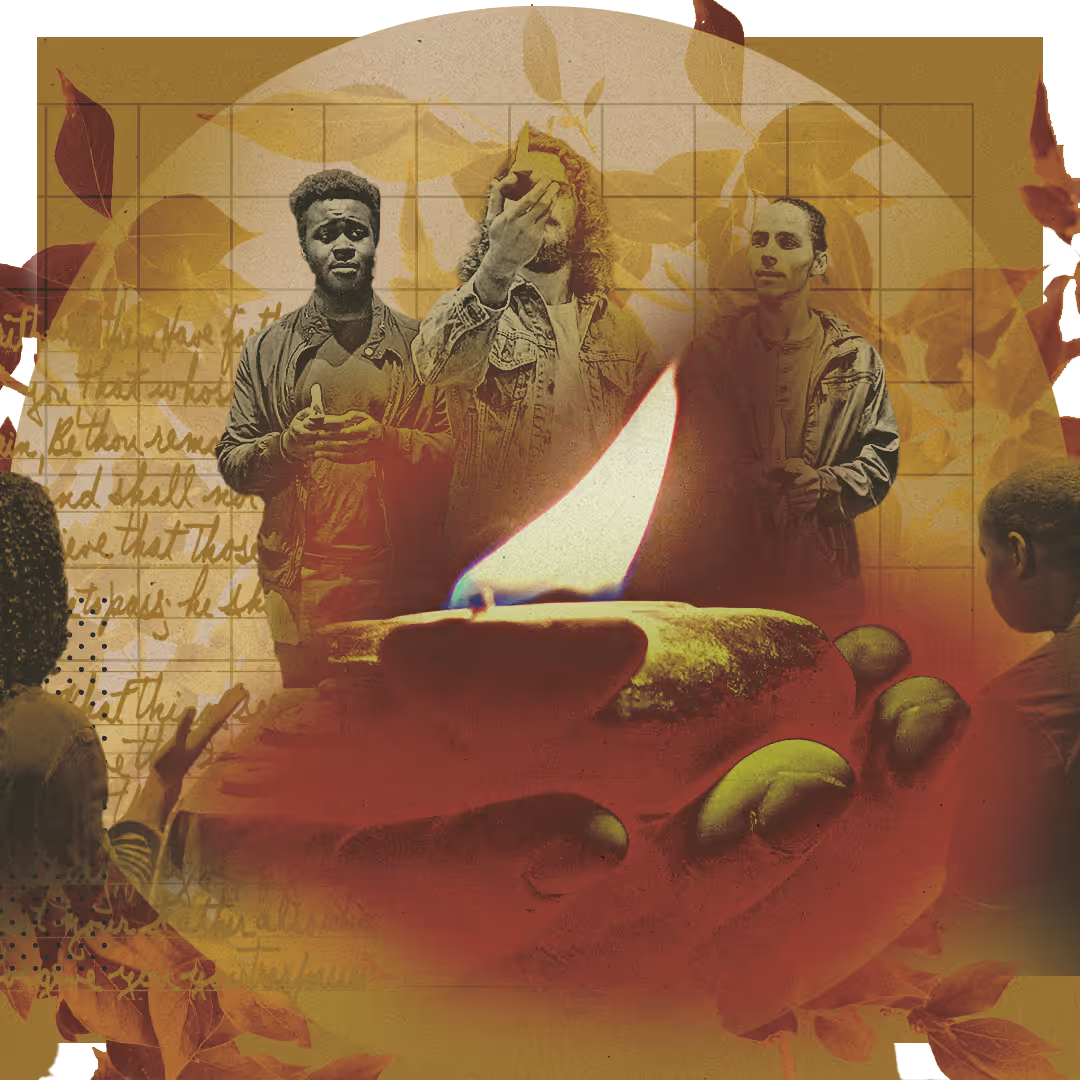
David: [upbeat music] How can we survive in the holy theophanic cloud of God? It's if we are like him. It's what Leviticus says, the solution is, "Be holy as I am holy."
Christine: [upbeat music] Welcome to the Spoken Gospel podcast. Spoken Gospel is a ministry that's dedicated to speaking the gospel out of every corner of scripture. In Luke 24, Jesus told his disciples that every part of the Bible is about him. In each episode, hosts David and Seth work through a passage of scripture to see how it's all about Jesus and his good news. Let's jump in. [upbeat music]
David: Well, welcome, everyone, to the Spoken Gospel podcast. Thank you so much for joining us on our second episode, looking at the Book of Acts. I have returning with me our friends Christine and Josh, ready to dive in and continue our conversation. Last time, we looked at Acts 1 and talked about this orderly account that Luke was hired by Theophilus to put together of what Jesus began to do in volume one, the Gospel of Luke, and what he continued to do in his church in the accounts of Acts of the Apostles. And we saw how there's a lot of kingdom language, and a lot of the idea of the Kingdom of Heaven, the Kingdom of God advancing in the world in chapter one. We see even the disciples asking, "Is now the time that the Kingdom of Heaven is going to come to Israel?" And Jesus tells his disciples that he's going to make them his witnesses, his martyrs, to take him and the proclamation of his kingdom from Jerusalem to Judea and Samaria, all the way to the ends of the earth. And we talked about how this is the plan from the Garden of Eden, that God would partner with his kingly people to bring his rule and reign as they are fruitful and multiply around the world, deposing the beastly empires, the snake-like kingdoms that had filled the world, and take their thrones. And we talked about these thrones that came from the Book of Daniel in chapter seven, where you had this Son of Man and Son of God riding a cloud, bringing Heaven to Earth, and deposing beastly empires, and then bringing his followers to rule and reign with him on thrones. And that's what we kind of see as the apostles start to go, "Hey, there's only 11 of us, and there was supposed to be 12, and now we need to take the thrones and start ruling this kingdom." And they were told to wait until the Holy Spirit would come and empower them from on high to do this work that God had given them to do, and that is where we find them, waiting for this power. Anything to add to that [chuckles] as we look at this synopsis? I've, I've tried to lay the groundwork here. What do you guys think?
Christine: That was episode one in two minutes-
David: All right.
Christine: So good job.
Josh: Yeah, it's great.
David: Okay, cool. [laughs] So Acts 2 opens on the day of Pentecost. What is Pentecost? Christine, why don't you take a stab at it?
Christine: Pentecost is an ancient Jewish festival that was celebrated annually, and it commemorates the giving of the law at Sinai in Exodus that occurred
Christine: 50 days after the Passover and exodus from Egypt. So after God deposed the powers and conquered them and rescued his people-
David: Mm
Christine: ... he led them through the Red Sea, through a baptism of sorts, and to a mountain where they would experience him in the raw, as it were. And it was scary, but a very big moment because they received the covenant that bound them to God forever, and the law given to Moses on the mountain. So that's where we get our name Pentecost from, 'cause that's, that has 50-
David: 50
Christine: ... in it. And yeah, that's what I got. [chuckles]
David: No, it's really good. I, uh... What I'm hearing in that, Josh, I wonder if you're hearing it, too, like, so many elements that we're going to see fulfilled in the day of Pentecost.
Josh: Yeah, as she was talking, I was just like, "Oh," just, like, being reminded of, like [chuckles] the day of Pentecost, and like, "Oh, all these different elements that are tied to that story."
David: Yeah.
Josh: It's really cool.
David: 'Cause let's review them real quick, 'cause I think that's actually really helpful. There's this deposition of the powers when God, Yahweh, redeems his people from the land of Egypt and humiliates the Egyptian gods through the powers of the plagues and by swallowing the god-man, Pharaoh, in the Red Sea and triumphing over him. Then, like you said, there's this... Is it a 40-day trek to the Mount Sinai from there?
Christine: That's kind of-
David: That's-
Christine: ... the idea.
David: Okay.
Christine: And then they have to spend a few days purifying themselves and consecrating themselves in preparation to meet God.
David: Yeah, but you also mentioned the baptism of sorts, which we're gonna see baptism pop up. They cross through the Red Sea, and Paul talks about that in 1 Corinthians. Is he talking about, like, the baptism into Moses?
Christine: Of Moses, yes. The Israelites were baptized into Moses's life, which essentially means what Moses experienced is what he can bring the Israelites into experiencing. So Moses, in his infancy, underwent a sort of baptism, being drawn out of the water, and so the Israelites experience the same thing. And Moses goes up onto a mountain and has an encounter with God there at the burning bush. He sees a fiery, like, vision of God speaking to him, and then God tells Moses in that moment, "Your sign will be that you will bring the Israelites to worship me in this place." And so being baptized into Moses is being baptized into Moses's experience of God.
David: That's blowing my mind right now. [laughs]
Christine: Okay, well-
David: I've never put that together before.
Christine: Real- well, it tees up what-
David: That's so cool
Christine: ... so bap- being baptized into the name of-... the Father, Son, and the Holy Spirit-
David: Yeah
Christine: - is being baptized into the experience of [chuckles] -
David: Wow
Christine: - God.
David: Well, I mean, that's exactly how Paul, Paul talks about it in, like, Romans 6, for example, where he says, "As many of you have been baptized into Christ, have been baptized into..." And then he, he says, but I'll say, "Into his experiences, what he's done."
Christine: Yep.
David: You ba- were baptized into his death, you died with him, and then you were raised with him to life. You're seated with him at the right hand of God. Whatever he experienced, you are in because you've been baptized into him. And so for Moses, you're saying he passed through death to life, through water in his infancy, and then met God on a mountain at the burning bush, and now Israel passes through death to life through the Red Sea, and then meets God on a mountain at Mount Sinai.
Christine: Yes.
David: That is so stinking cool. [chuckles]
Josh: Wow.
Christine: You are- your baptism into someone, in this case, Moses, is participating in that person's experience of God and that person's life. And so very sadly, also, the generation Moses brought out, Moses can only bring so far, 'cause Moses dies in the wilderness-
David: Yeah
Christine: ... as do the people he brought out.
David: Mm.
Christine: And so there is a sense in which that's the extent to which the person you are baptized into can take you.
David: Whoa.
Christine: So [chuckles] -
David: So if we're baptized into the one who can take us all the way to God-
Christine: Yeah, into the-
David: ... that is good news. [chuckles]
Christine: That seems to be what's on the line here.
David: That is really cool. Okay, so Pentecost is also known as the Feast of Weeks, right? Because it's-
Christine: Mm
David: ... seven sevens. It's seven-
Christine: That's right. Wow
David: ... weeks of seven days, which is 49, and then on the 50th day is the kind of new creation, the jubilee moment, in a sense, where you have this perfection of perfection being reached.
Christine: It's a reset-
David: It's a reset
Christine: ... to the original. The Kingdom of God has a, like, a default position where everyone is free and in their, uh, in their own place-
David: Yes
Christine: ... and in right order with God and with each other, and they were supposed to commemorate this with the jubilee cycle-
David: Right
Christine: ... which sadly, they never did. But the idea was you revert to the original setting, the way things are meant to be.
David: I see, 'cause so the year of Jubilee, which was the 50th year after seven sevens of years, you did have this gigantic economic, social reset where lands returned to its original owners, slaves were freed, debts were forgiven, and it was this huge reset, and that's what you're talking about.
Christine: Yes, which I think is very cool to think about Pentecost as-
David: God's giant reset button for the world? [chuckles]
Christine: ... as a sort of returning to what we were originally intended. [chuckles]
David: [chuckles] That's really cool.
Christine: New creation and everything that you said.
David: Yeah.
Christine: So.
David: Okay, awesome. So Feast of Weeks, a giant, new mega Sabbath reset button for new creation to come in and restore what's been broken in the world.
Christine: Recovery of sight to the blind.
David: Yeah, this is what Jesus came proclaiming, and that Luke, especially as the author, highlights in chapter four of his gospel-
Christine: Yep
David: ... whenever he reads from the Isaiah Scroll.
Christine: It's like he meant to do that or something. [chuckles]
David: It's like he meant to do that or something. It's like he was setting something up for volume two, for poor, for sweet, sweet Theophilus, lover of God. Okay, that's amazing. Josh, anything you're hearing that you wanna chime in on?
Josh: No, I'm just processing.
David: Me, too. Yeah. [chuckles]
Josh: That's a lot to take in in the first five minutes. [laughing]
David: [laughing] Welcome-
Josh: I was not expecting that.
David: Welcome, everyone.
Josh: [chuckles]
David: Yeah. Okay, well, good. If, if it makes you, Josh, and anyone else listening feel better, I had never heard mo- most of what [chuckles] Christine just said, either, and it's really cool.
Josh: It's beautiful.
David: And it's really helpful, too.
Josh: Yeah.
David: 'Cause I've always wondered, like, when Paul... Is it 1 Corinthians 10 where he talks about being baptized into Moses? I'm like, "What does that mean?"
Josh: Yeah, and I think, I think for me, too, like, there are all these details about number- like, different numbers, like 40 and, you know, 50, and it's- I've always struggled with, like, "Oh, what's the meaning behind that?"
David: Mm-hmm.
Josh: And so thank you for [chuckles] painting that picture really well, especially the connection with Jubilee and the 50 years, like, wow. Yeah, Pentecost, giant reset button.
David: Yeah.
Josh: That's awesome.
Christine: 40 is preparatory, too, in the Bible.
David: Mm.
Christine: If there's a 40, it means something better is coming, and so-
David: 40 years in the wilderness-
Christine: 40 years
David: ... leading to a promised land.
Christine: Yes.
David: Yeah.
Christine: Or 40-
David: 40 days-
Christine: ... days and 40 nights
David: ... fasting.
Christine: Oh, I was thinking 40 days and 40 nights with the flood.
David: Oh, the flood.
Christine: Like, that is prep-
David: Yes
Christine: ... like, that's the rain-
David: For a new creation
Christine: ... prep for a new creation. And you look at how long Saul, the first king of Israel, reigned. It was only 40, only 40 years, but that is like, "Oh, that means a better king is coming."
David: Mm.
Christine: "Oh, look, it's David. Oh, yeah, he is a better king. Wait, he reigns for 40 years also."
David: Yep.
Christine: "Oh, but he has Solomon. Oh, Solomon is the king we're waiting for. Oh, wait, Solomon also reigns for 40 years."
David: Mm.
Christine: "There must be a better Solomon coming."
David: Yep.
Christine: That's kind of the... What 40 per- 40 is supposed to indicate we're getting ready for something, we're preparing for something, and something bigger is coming.
David: Yeah, and aren't we told there's a 40-day period in Acts chapter 1?
Christine: Yes, yes.
David: Yeah.
Christine: "For 40 days, he taught them," this is the end of verse three. "He appeared... He, Jesus, appeared to them over a period of 40 days and spoke about the Kingdom of God."
David: Mm. It's mind-blowing to me, especially setting up that paradigm of flood leading to new creation, 40 days of Saul leading to King David, to then say, "Jesus, resurrected Jesus, hanging out with his disciples on Earth, talking about the Kingdom of God, that that's not the ultimate."
Josh: Yeah.
David: That that's preparatory?
Josh: Yeah.
David: I'm like, "That, that sounds like blasphemy." [chuckles]
Josh: It's preparatory for something better-
David: Better than that?
Josh: ... that's coming. That is better.
Christine: How can you get better than Jesus resurrected, hanging out with you in the flesh?
David: Right. Exactly, yeah.
Christine: The 40 seems to indicate there's something big on the horizon.
David: I remember reading a book about the Holy Spirit, and I'm so sorry, the person who I'm about to quote and not reference, 'cause I can't think of your name or the name of your book, but the subtitle of the book, you guys can look it up, is, "Why the Holy Spirit inside us is better than Jesus beside us."... and that like, I was like-
Christine: Oh!
David: I'm like, "How-
Christine: That-
David: "How, though?"
Christine: Yeah, wow.
David: Like, yeah, how is Jesus being with him, with these people 40 days preparatory, is just blowing my mind. But I guess we'll look at it.
Christine: There's a dedication.
David: There's a dedication.
Christine: And a filling.
David: So we'll talk about it.
Christine: 'Cause new creation means filling, too.
David: Okay, so we've set it up. We've got Pentecost is here, the giant jubilee reset button, the 40 days of preparation are over. Jesus, the cloud rider, has ascended into heaven to bring heaven to Earth, and here it is on the day of Pentecost. Chapter two, verse one of Acts: "When the day of Pentecost had come, they were all together in one place, and suddenly from heaven, there came a sound like the rush of a violent wind, and it filled the entire house where they were sit- sitting. Divided tongues, as of fire, appeared among them, and a tongue rested on each of them. All of them were filled with the Holy Spirit and began to speak in other languages as the Spirit gave them the ability." Okay, I feel like there's a lot happening already. So Christine, what's jumping out at you in terms of first priority? What's screaming at you that you wanna talk about in those first three verses?
Christine: Wow. [laughing]
David: [laughing] Just wow! Yeah, just fair.
Christine: Just one thing. [laughing] There's-
David: What's first?
Christine: ... um, giant wind that comes, that fills the house.
David: Yeah.
Christine: And there is this
Christine: huge flame that splits, and separates, and rests on each of them, and then they start speaking in different languages-
David: Yeah, so let's talk about those
Christine: ... and it's the Holy Spirit that fills them.
David: Yeah, so-
Christine: I just re-summarized it, but- [exhaling]
David: Okay, so a mighty wind from heaven comes. What is this imagery?
Christine: New creation.
David: Why is it new creation?
Christine: Well, in the beginning, the Spirit was hovering over the waters.
David: Oh, my gosh.
Christine: There's a wind-
David: Oh, and, and just because wind and spirit.
Christine: Yes, that's the same word, I think, in both Greek and Hebrew.
David: Mm-hmm.
Christine: And then w- we mentioned the flood, 40 days of preparation, and how did the floods recede? There's a giant-
David: A giant wind
Christine: ... wind that blows them down, and-
David: Oh
Christine: ... what surfaces is community of people on a mountain.
David: On a mountain, [laughing] in a high place, ready to meet with God and send new creation out into the world by being fruitful and multiplying, and everything else we talked about. [laughing] That's amazing.
Christine: Basically.
David: It's so cool.
Christine: Basically.
David: Yeah, okay.
Christine: Big reset for the world.
David: So, so when it talks about a giant- the sound of a giant rushing wind, are we meant to think this is the Spirit of God, like, coming into the place, or is this something different? Or is that a bad question? [laughing]
Christine: It says, "A sound like the blowing of violent wind." Well, I don't know what the original means there, that it's like a w- violent wind.
David: Mm.
Christine: Is this a wind that's
Christine: extremely loud, or is this a sound that is reminiscent of a mighty wind outside? 'Cause we're inside a house at this point, there's no draft.
David: Right.
Christine: So-
David: Yeah, so but we do know the Holy Spirit comes.
Christine: Yes.
David: And we do know that these mighty winds are precursors and agents of new creation after seasons of preparation.
Christine: Yes.
David: And so we, we at least know that's happening. [laughing] The physicality of it-
Christine: Right
David: ... we probably, isn't as important, probably.
Christine: And we mentioned Sinai earlier. There were many loud noises at Sinai.
David: So much so that people did not even wanna listen anymore. It was terrifying.
Christine: Yes, there were... There was an increasingly crescendoing trumpet blast.
David: Mm.
Christine: There was thunder, there was lightning, there was... I think it might have begun with the wind, and even the mountain was shaking, so-
David: Yeah. It's very similar here.
Christine: A visitation is loud. [laughing]
David: Yeah.
Christine: But-
David: And so when we t- when we think about Sinai, I know it's this, for those who, who aren't familiar with this, it, it is th- the mountaintops are the abodes of the gods. They are these places where humans would go to meet with the gods. 'Cause they're kind of like these tips of the spear, where Earth reaches up into heaven, and the two overlap. And so at Sinai, you have this mountain where God and man come together, and it's talked about in these ways. Uh, the nerdy scholars who use annoying long words call it the theophanic cloud, and it's this... A theophany is an appearance of God. So theo, God, yeah, like a theophany, uh, is God showing up and appearing.
Christine: Kinda like who Luke is writing to?
David: Kind of like who? Oh, uh, Theophilus.
Christine: Theophilus. Okay. Oh, yeah.
David: Yeah, okay.
Christine: Well, we have theos at the beginning-
David: Yeah
Christine: ... which is God.
David: That's funny, though. [laughing] Yeah, um, and so you do have this, in a sense, a theophanic cloud, like was at Sinai, with lightning. And remember, if you listened to last episode, we talked about how when the Bible talks about fire coming from heaven, it's describing lightning. And so you have lightning and or fire coming from heaven, you have loud winds, and you have loud sounds. That's the theophanic cloud at Sinai, and now that cloud is coming into the upper room where the apostles are. This theophanic Sinai cloud is coming in where the apostles are. And I remember you mentioning one thing, is, is that Moses was the only one in the cloud at Sinai, uh, at least the only human [laughing] in Sinai, and now there are many.
Christine: Yes, that's a notable difference, that
Christine: when God appeared at Sinai, there were very strict laws about not coming near the cloud because people would die, 'cause the whole cloud would be- or the whole mountain would be holy. And people were fine with that, 'cause they were terrified, [laughing] and even Moses was terrified, according to Hebrews. But there was this limitation that only Moses could approach the big cloud mountain where God was.
David: Yeah, and is that because he was-... chosen, set apart? Is it because he was holier? Is- uh, he didn't have to go through different rituals in order to cleanse himself a certain way.
Christine: No, but he was going on the people's behalf-
David: Behalf
Christine: ... in a way.
David: Like as their priest.
Christine: I guess so, yeah.
David: Yeah, and so I'm, I'm just trying to say, what's the significance of the many being on this new mountaintop versus just Moses? Is this saying, "The many are now made priests, the many are now pure. I'm sending the many." Um, like, what's the, what's the significance of it not just being Moses anymore?
Christine: I think, I'm just processing this out loud. The, the time when the spirit that was on Moses was distributed was only one time, and that was when God said He would put some of the Spirit that was in Moses and put it on multiple others.
David: Right.
Christine: And that happens to elders who don't even show up, to kind of show that this is God's doing, not just the fact that Moses can gather a bunch of people together. And some people complained about that, or someone complained about that, saying, like, "Why are they prophesying?" And Moses is like-
David: "I wish everyone would prophesy."
Christine: ... Would that all God's people would prophesy. So there's this wish of the Prophet Moses that the Spirit of God would fill all God's people.
David: Okay.
Christine: And here's someone greater than Moses, the prophet greater than Moses, who's just sent His Spirit.
David: Okay, let me re- let me try to recap that-
Christine: Sure
David: ... 'cause I feel like you've put your finger on something cool there. Where Moses goes into this theophanic cloud, and it seems like, be it there or some other time, maybe in the theophanic cloud, though, he receives the Spirit of God. I don't know. We don't need to say when or where, but there comes another time when God distributes the Spirit He's given to M- Moses, where it's divided and given to more, but not everyone.
Christine: Yes, only the elders.
David: Only the elders. But now, at Pentecost, everybody in the room's getting it, and they're about to go out and baptize other people into Jesus, and they're going to receive the gift of the Holy Spirit. And so this divided Spirit is about to fill more and more and more, and this hope or profession that Moses said, that, "I wish all people would prophesy," is coming true.
Christine: Yes, and you'll remember that, again, being baptized into Moses means you can participate in his experience of God, and so part of this Spirit distribution was a bit of that, and it was temporary. And another temporary example was in Exodus 24, when God permits Moses to bring up elders-
David: Mm-hmm
Christine: ... to go and have a meal with Him-
David: And have a meal with God [chuckles]
Christine: ... on the mountain [chuckles]-
David: The coolest part of the Bible
Christine: ... of God. It's the coolest part ever. And all that is good and great, but it's a temporary moment there, and we see where Moses ends is in the wilderness. He doesn't enter the Promised Land. But this isn't the first time Luke has talked about the Holy Spirit descending. You know, at the beginning of his gospel, someone else gets baptized. It's Jesus, and He comes up out of the water, and the Spirit-
David: Right
Christine: ... comes down, and there's a voice speaking, and-
David: Ah, and so, so Jesus, in that moment, is kind of like the new Moses, where He receives the Spirit. But now, whereas when Moses' Spirit gets divided among the elders, when Jesus comes to His people to divide it, it goes into everyone.
Christine: That's right.
David: Because He's the new and better-
Christine: Yes, it's the bap- baptism-
David: ... Moses
Christine: -of Jesus and being baptized into Jesus that we receive the Spirit.
David: Oh, that's so cool.
Christine: He received, and it doesn't leave Him. [chuckles]
David: Okay, so we've got this upper room. We've got the theophanic cloud, people in a new Mount Sinai. They're receiving, again, the Holy Spirit. So I, I know we talked a, a second there about this holy mountain, and it's holy because, not because of the rocks necessarily. It's holy 'cause who's on the rocks? It's God is there, and now the Holy Spirit, that theophanic cloud of the presence of God, is here among the people. But they're, they're standing in it and being suffused by it and in Him, and it's incredible. Wow! Anything else to pull out there? I guess tongues are interesting. We, we've talked about-
Christine: Tongues of fire
David: ... tongues of fire. We've talked about fire being accompanying the, the wind and the cloud and the thunder as lightning. We've talked a little bit about the dividing as this Spirit is not just for one but is for everyone who it's given to.
Christine: Yeah, this isn't just the 12 apostles gathered. It's the whole crowd.
David: That's right.
Christine: Yeah.
David: Yeah. Uh, why is it tongues of fire or like tongues of fire and not just fire? Like, what am I supposed to have in my head? I've always wondered [chuckles] like, what's the picture of a tongue of fire? Is it just a, a loose mouth muscle floating in, on fire above someone's head?
Josh: Yeah, do they mean like a literal tongue-
David: Right
Josh: ... with that? Yeah.
David: Yeah.
Josh: I don't know. I always picture, like, you know how in Sims, you have, like, that little diamond-
David: The little green diamond? [chuckles]
Josh: ... ab- above, above someone. I always just picture, like, a little flame-
David: Yeah
Josh: ... just, like, above someone's head, just-
David: Yeah
Josh: ... following them wherever they go.
David: Any thoughts on that?
Christine: Is that not an idiom or the expression for a flame, like, on a candle?
David: Oh, it licks! Like, the flame licks.
Christine: Yeah, like a tongue of fire is a-
Josh: Oh, that makes sense
Christine: ... is a flame, such as on a candle or something like that.
David: This has been Christine Brings Josh and David Down to Earth.
Christine: [laughs]
David: Um, for next episode, please tune in. [chuckles] Yeah, that's so good. Yeah, it's a- yeah, it's an idiom.
Christine: We're on a mountain. I don't wanna drag you down.
David: No, no, but it's so true. We're talking about these images, trying to talk about the theophanic cloud, and now you have these licking flames. That's how we describe what flames do: they lick.
Christine: They flicker.
David: They flicker.
Christine: Yeah, and this is one that actually moves and descends, which reminds me of the pillar of cloud and the pillar of fire that was following, or rather, that people with Moses followed in the desert.
David: Yeah.
Christine: And it dis- and at one point, it fills and consecrates the tabernacle.
David: Yes, it does.
Christine: And so much so that no one can enter in.
David: Yep.
Christine: God has filled His dwelling place, and no one, not even Moses, can enter.
David: That's the end of Exodus.
Christine: That's the end of Exodus, and the big question is-... how do we-
David: Interact?
Christine: Now that God has come, how do we interact with him? And that's what Leviticus is all about.
David: Yeah.
Christine: But here we have a filling where the true tabernacles are full, the true temple has been dedicated.
David: In people.
Christine: In people.
David: Yeah.
Christine: Yes.
David: So everything that the temple and tabernacle prefigured is coming true here, where we have the filling of the- I, and I think you could argue, the first theophanic cloud that fills a temple is in Genesis 3, when God shows up. And it's not- it kind of gets lost in our English translation a little bit, but some of the language there, when God shows up and is like, "Hey, Adam, where are you?" Is the language, the cool of the day language, is this kind of cloud.
Christine: The ruach of the day.
David: Yeah, it's, it's the spirit cloud language. And so we have this idea of the theophanic cloud of God in the Garden of Eden, and then that theophanic cloud comes and fills the tabernacle at the end of Exodus, which is what Christine was talking about. And then when Solomon builds the temple, it happens again, and the smoke of God, the cloud of God, comes and fills the temple again. And that's how you know God is saying, "I will dwell here. I am dwelling here. I will make my residence here," which is the Mosaic Covenant. Just to pause there, that's probably a good thing to bring up, is, you know, Pentecost is celebrating when the law was given. Well, what's so great about the law?
Christine: The covenant.
David: The covenant, which is, "I will be your God, you will be my people." That's the covenant. And the kind of... It feels so almost blasphemous to say it's a letdown, but the letdown, even in the story, it kind of feels like a letdown, is, "All right, I'll dwell in the tent." And it's like, "Oh, that's good. I'm really glad you're in the tent."
Christine: Yeah, it's the tent of God that-
David: Yeah
Christine: ... came down the mountain of God. So it, it becomes a mobile mountain of God, as it were.
David: That's right.
Christine: And it's very holy, and it, it's great that it's among us, but we can't just act however we want.
David: Right.
Christine: We have to acclimatize to the holiness. We have to become pure, holy, set-apart people.
Josh: Like, there are rules to come near it and come close to it.
Christine: Yes.
Josh: So it kind of reminds me maybe of like, uh, like in Eden, when Adam and Eve are exiled, there's a cherubim with a flaming sword-
David: Mm
Josh: ... on fire, guarding the way to the entrance, so you can't get back in. And then now, now that you have this imagery of fire resting on people, it's like, oh, like Eden now dwells in you.
David: Yeah.
Josh: Kind of this-
Christine: Will this fire burn us up, or will it purify us?
David: Yeah. We don't know. It's like, when the story's happening, you might be wondering, "What's going to happen inside this theophanic cloud of fire and lightning and wind?"
Josh: Yeah, are they gonna die?
David: Yeah.
Josh: Yeah.
David: Is this bad news for them, [chuckles] or what's going on? Yeah, and I, it's interesting, too, I've heard a, a friend say that the cherubim with the flaming sword guarding the way to the Garden of Eden is this early signal that the way back into the Garden of Eden is through death. Uh, and it's this picture out- throughout the whole Bible, is death actually leads to life. And Jesus inaugurates that way, in that, how can we survive in the holy theophanic cloud of God? It's if we are like Him. It's what Leviticus says, the solution is, "Be holy as I am holy." And so we need to become holy, and this happens in several ways, that I think even Peter's going to talk about, and that this passage unpacks.
Josh: And baptism itself is like, whenever someone is baptized, it's like a, like their old life is dead.
David: That's right.
Josh: And there- and so this is the baptism of the Holy Spirit.
David: Mm-hmm.
Josh: And so could you even make that argument of like, oh, so, like, your old life is dead, and now you're alive with Christ in the garden.
Christine: It's a reset, new creation.
David: Mm.
Christine: Like, you are-
David: The wind is pushing back the waters of the flood.
Christine: Yes, a new jubilee, a new rest, a new freedom, a new beginning has occurred.
Josh: So, like, unlike in Eden, when, you know, when they heard God walking in the cool of the day, Adam and Eve, and they hid, now they are fully visible and, like, in the garden and able to be with God in unity.
Christine: Yeah, there's nothing between God's Holy Spirit and his people right now [chuckles].
David: Yeah.
Christine: Which, kind of like how you were saying, it doesn't leave us begging the question too long, but it's kind of like this is holiness filling the people of God, what's going to happen? We've seen holiness
Christine: bless people. We've seen it cause, you know, people to die because holiness is just that separate and, and unique, that, okay, what's, what's gonna happen here? And they are empowered to do something really cool here, which will be to proclaim the Kingdom of God.
David: Yeah, they... Is it that they become holy because they have the Holy Spirit with them? Like, why... W- we're not given the mechanics, in a sense of-
Christine: Yeah
David: ... of, of why-
Christine: We're not told how
David: ... or why aren't they burned up, or why aren't they put to death? Why is it power that they receive and not death?
Christine: Yeah. Yeah, and the only thing I was, like, trying to parallel there, is that the filling of the tabernacle and the filling of the temple pushed people out of the habitation of God. God was filling a locus that could not be entered, even by the consecrated priests. And so here, there, we have something different. We have the filling of the tabernacle again, but this time it's the people themselves.
Josh: Why couldn't the priests enter?
Christine: Just says, "God descended, and the priests could not perform their duties." [chuckles]
David: Yeah. There's too much going on in there.
Christine: Like, okay. [chuckles]
David: Yeah. I mean, one thing it makes me think of is, if this is the theophanic cloud, I've got Exodus in my head. I've got this, "You can't enter into the big smoke cloud of God, especially if you're not right [chuckles], and, and if you're not wholly like Him." It does make me think that there is something new that has happened in the world [chuckles] that is making this moment possible, and it is the fact that Jesus has died, has risen, and now reigns, and is sending... And, and that then allows Him to send His Holy Spirit, and that His Holy Spirit can now dwell with man-... because his death, burial, and resurrection has accomplished something that previously was not accomplished, which is the remaking and the cleansing of humankind through the sprinkling and shedding of his blood.
Josh: I see. So the idea that, you know, before Jesus, let's go, Christine, you were- 'cause she was talking about, like, the fire. Does it kill or does it purify? So-
David: Yes.
Josh: Before Jesus, like, if, yeah, picturing God as fire, um, his holiness as fire, if you get too close, you'll die because we are dirty and sinful, and we'll burn up. But now, because of Jesus and what that accomplished, we have been cleansed, and so now that fire is purifying us. It's making us holy. Um, it doesn't kill us anymore. Is that one way to describe it?
Christine: I have no idea. [laughing]
David: [laughing] Yeah, we're not, again, we're not told a- about this here, and this is, this is- these are big categories, uh, I think, that we're trying to wrestle with. But it is this idea that there's something in the L- Levitical system that we're told about after you couldn't enter into this tabernacle, that there's a way to become clean, and then you can enter in... And then certain people and certain priests at certain times can enter into certain holy places or interact with certain holy things, and that interaction with holy things makes them holy. And so here we have Jesus cleansing his people, um, as the ultimate sacrifice, and applying that as the ultimate priest to his people, and now they are clean, and so they can interact with a holy thing or with the most holy being, the Holy Spirit himself, and it becomes an empowering. It actually makes them like him. It makes them holy as he is holy, and then they start going out and doing his works, which is what we're going to see. They actually do become like him and continue to do what Jesus was doing. And so, um, he inhabits his people, and they start acting as his holy self in the world, which is crazy.
Christine: Yeah. Jesus was filled with the Spirit at his baptism, and then-
David: That's right
Christine: ... went out and defeated the, the serpent in the wilderness by overcoming every temptation, and then he went and proclaimed that the Kingdom of Heaven was near. And we see
Christine: this as well with the Holy Spirit coming, kind of like with Jesus, and then the apostles are about to go and proclaim that the Kingdom of Heaven is here. It has come. Jesus has defeated the powers, and you're talking about, like, the cleansing and the ultimate offering of the high priest. Like, this is the heavenly Day of Atonement that every annual Day of Atonement was pointing to, that, okay, cosmically, the world is purified, so the Spirit can come and be with his people, and it's okay.
David: Yeah. He's remade the cosmos through his sacrifice so that he can dwell in it in a new way
David: because he's cleansed it and bought it and purified it. It's just crazy! Cosmological purification [chuckles] through the-
Christine: Yeah
David: ... death and resurrection of Jesus.
Christine: Yes.
David: Yeah.
Christine: 'Cause we had holy people and holy time and holy spaces in the Levitical and-
David: The Torah system
Christine: ... the Torah system, and all of those, all those aligned, especially at the Day of Atonement, where the most holy human, the high priest-
David: Mm
Christine: ... could go into the most holy place-
David: The holiest, holiest
Christine: ... the Holy of Holies, and that time that he could go in was on the Day of Atonement, which is the holiest time. And at that time, the entire tabernacle and space became like this, atoned for, covered, cleaned space.
David: Which God would fill in a unique way on that day.
Christine: Yes, all people's sins would be forgiven.
David: Yeah.
Christine: And so all of that, because the tabernacle was this microcosm of the world, and the priest was a microcosm of Israel, who was a microcosm of the nations, and this one day on, in the calendar was a microcosm of the year, people understood that all of these were pointing to a global-
David: Yeah
Christine: ... well, global-
David: Yeah
Christine: ... a worldwide-
David: Worldwide
Christine: ... cleansing, a worldwide day of atonement that would be achieved by the ultimate high priest, which would ultimately sanctify or make holy the world.
David: So that's why when Hebrews talks about when Jesus dies and rises, he takes his- he makes atonement even in the heavenly places, of which the earthly things were only a shadow or a copy, and that he actually does apply the cleansing blood that he shed to all of the created order so that he can now come and dwell in it in a way that he... Like, in, on the Day of Atonement, like, his Holy Spirit, the theophanic cloud, can actually come into the created order to rule and reign and dwell with his people in a way that it never could before that happened.
Christine: He went into the heavenly tabernacle, as you said-
David: Yeah
Christine: ... and Hebrews unpacks all of this, so just go and read Hebrews and see how that gets unpacked because it's amazing. But the whole idea there is that the great high priest has made the sacrifice. Everyone's holy now, or the world is holy. The world is clean.
David: The world is clean and can now interact with holy things.
Josh: Mm.
Christine: Yes. Yes.
David: I.e., the Holy One, the Holy Spirit.
Josh: So what a priest would accomplish in the tabernacle, Jesus has accomplished in the entire world.
David: Yes, that's it! Thank you, Josh. That's it. [chuckles]
Josh: Yeah.
David: Yeah, yeah. [chuckles]
Josh: Which, uh, I think-
David: This has been Josh bringing Christine and David back down to earth. [chuckles]
Josh: Well, but I think Peter talks about that in his sermon, where, I think, right? Uh-
Christine: Excellent segue, Josh.
David: Well done. Very good. So yes, the apostles, they go out with these other languages that they're speaking and start to proclaim the Kingdom of God to everyone that's out there, and you've got this huge melting pot of people from all over, different nations, and they've come to be a part of... Maybe they've been there since Passover, if they had the means to stay long enough to stay 50 days [chuckles], or maybe these people have just journeyed in here to celebrate Pentecost, uh, the Feast of Weeks. And so they go out, and they start to present the news about the Kingdom of God and the great works that God has done through Jesus, but everyone's hearing them in their own language, even though they're not speaking that-... maybe a certain language, they're hearing it in their language, which is just a phenomenon that can only be explained through God. [laughs]
Christine: The Word.
David: The Word. The Word goes out, and people understand it. And so this also is a huge moment in, in showing this cataclysmic and universal shift from an old order of things to a new order of things. So as we think about all nations and all languages starting to hear a united message, this reminds us of what, Christine? [chuckles]
Christine: That reminds me of the Tower of Babel, where languages were confused, and it scattered people.
David: Mm-hmm. And what, what was the occasion for the Tower of Babel? Like, what, like... I think this is important. Like, what led to the Tower of Babel, and then what were its consequences?
Christine: So the people
Christine: conspired to gather together, contrary to God's command to spread out-
David: Mm
Christine: ... because they wanted to bring God down. They want to m- they wanted to make their own version of God's mountain and bring God down to their level-
David: Right
Christine: -or worse.
David: So they build this tower, this ziggurat, this-
Christine: They, yeah, this enormous tower, ziggurat, and it's all, it's all presumption [chuckles] and-
David: Mm
Christine: ... pride, and in a sense, a, yeah, a revolt. And despite all their efforts to get as high up as they can, God has to come down [laughs] and-
David: He comes down, yeah
Christine: ... as the text, and looks at their little project, and He says, "This isn't going to work. They're actually gonna destroy themselves trying to do this." And so He confuses their language and scatters them so that they could no longer understand one another. And so that is when the nations all get divided, and we see a lot of nations united here-
David: Mm
Christine: ... and not being confused, but actually hearing their languages-
David: Yeah
Christine: ... spoken.
David: So at the Tower of Babel, the nations come together in order to try to basically find a way to live life without the Most High God, that they could manipulate or summon or control Him in some way, and therefore actually not need Him and not live in this state of dependence that God longs for with His people. You know, it's the same thing Adam and Eve did.
Josh: Right.
David: They're like, "I'm gonna figure out how to do this without You." And so God's like, "I'm not gonna let you live on forever in a state apart from me, because that would be hell on Earth, and so I'm gonna confuse your language and ruin this project." And it's from this that the nations are born, and the divisions of mankind are created, and it's also at this time that we start to see all these nations pop up that are very wicked and are ruled by wicked spirits and wicked kings and wicked powers, and they're all slaves to sin and death, and they start spreading all this horrible stuff into the world. And the solution that God gives is Abraham. [chuckles] "I'm gonna give you a son, a seed, and through him, all those nations of the world that are now scattered and ruined and oppressed are gonna be blessed instead." And this is what Jesus has done. He's the Son of Abraham, who has come to be a blessing to all these scattered nations, and it's here that we see it start happening. So how is Pentecost a reverse or an unworking of the Babel story?
Christine: Well, we kind of just said it. The, um, one thing that we also have there is that the scattering of the nations in this way, because of the confused languages and this rebellion, is creating distance between them and God.
David: Mm.
Christine: It's putting other rulers, other powers between them and God, and they just get farther and farther from God as a result, and God's solution is to pluck Abraham out of one of those [chuckles] and start or begin a brand-new creation through him. And so
Christine: here we just talked about Jesus being ascended in Heaven. He has deposed the powers, and it- this isn't the end of Luke's gospel. It's the end of Matthew's gospel, where he said, "All authority in Heaven and on Earth has been given to me." So he, a sense, has, again, repossessed the authority that he once gave these, these other powers-
David: Yeah
Christine: ... and is redelegating it to his disciples, saying, "Now go and take the nations." We talked about this in the last episode. This is a conquest of God's own world, but it's a reconquest because it was overtaken, but Jesus has now deposed it.
David: Yeah, so you have these nations ruled by other powers, and as Jesus has all authority over them, He's going to empty these powers of their thrones, take them from, and then put His people or His powers over these nations and free them.
Josh: Because these people know how to rule rightly. 'Cause unlike in Babel, where they want independence from God, God's people are dependent-
David: Yeah
Josh: ... on Him.
David: Yeah, they're joining the new nation-
Josh: Right
David: ... the new empire, the new Kingdom of God. [chuckles] And it's this new kingdom, this new country, nation, that's spreading, and it's God ruling over these wicked, you know, nations now through righteous governance, which He facilitates, yeah, through His people and through His created beings.
Christine: And Peter will say as much by quoting one of those Psalms near the end of his sermon, which jumping to verse 34 of chapter 2, where we'll go into why he brings up David and stuff like that, but he quotes Psalm 110, that, where David- he says, of David, that, "He did not ascend into Heaven," and yet he said, "The Lord said to my Lord, 'Sit at my right hand until I make your enemies a footstool for your feet.' Therefore, let all Israel be assured of this. God has made this Jesus, whom you crucified, both Lord and Christ." We'll get into more of that later, but the idea that the Lord that David is talking about is Jesus, and-... God says to Jesus, who is God, [chuckles] "Sit at my right hand until I make your enemies a footstool for your feet." This is, again, ref- referencing that conquest of, the enemies here are the enemy powers that are trying to drag the nations and the people away from God, and Jesus is now reigning in the midst of those powers. He's in authority over them.
David: Exactly.
Christine: Then He is putting His enemies under His feet, and He is doing that through His people.
David: Yeah, crazy. Okay, let's, so let's see where Peter starts his, his sermon. So he begins, and it's funny, I had never made this connection until we were talking about Moses,
David: and you have Moses, like you said, saying, uh, you know, seeing the, the Spirit divided amongst the elders, but then saying, "Oh, that I wish that all of God's people would prophesy." Well, that's what Joel, the prophet Joel, says will happen one day, and that's what Peter quotes here, which is so cool. I've never n- noticed the Moses to Joel to-
Christine: Oh!
David: ... Pentecost connection.
Christine: Yeah, that's cool.
David: Yeah, so Peter stands up and begins to talk to the crowd that's gathered there. Do we want to talk about [chuckles] that they thought they were drunk? [chuckles] Is- you do. Josh is nodding.
Christine: Yes, Josh is excited about this.
David: Okay, what, yeah, well, what's your question, or?
Josh: I just think it's... And I talked to Christine about this, how the mockers describe them as being drunk with new wine, which literally is not true, but, I mean, uh, when thinking about, like, the new wine and the new wineskins-
David: Mm
Josh: ... like that story that Jesus tells in Luke, like, uh, about the, the New Covenant. It's like, well, in a way, they are kind of drunk on new wine. [chuckles]
David: [chuckles]
Josh: Maybe not literally, but-
David: Right
Josh: ... uh, in a sense.
David: Yeah.
Josh: Yeah.
David: I mean, Paul makes that connection, right? Uh, "Do not be drunk on wine, but instead be filled with the Spirit."
Josh: Right.
David: We even call alcohol spirits.
Christine: Under the influence of a very strong one.
David: Yeah, [chuckles] that's a, that's a strong draft right there, the Holy Spirit. Talk about a mighty wind, that's a draft-
Josh: Drafty
David: ... anyway. [laughing]
Josh: So good.
David: So bad. Oh, man.
Josh: Yeah.
David: Okay, that's cool. Anything else there? That's fascinating.
Josh: No, that's the main thing for me.
David: They are-
Josh: Yeah
David: ... they are drunk on a, on a new wine.
Josh: Yeah, it's just a, a ironic mocking.
David: Yeah.
Josh: Yeah.
David: That's, it sounds like a very biblical thing [chuckles] -
Josh: Yeah
David: ... that happens a lot. Um, okay, yeah, so Peter starts his sermon by quoting Joel, chapter 2, I believe, and he talks about a day when God will pour out His Spirit on all flesh, and again, in order for that to be possible, this new world order will have had to occur because if God pours out His Spirit on all flesh, and He hasn't made the world clean yet, that's what Joel talks about as the day of the Lord when... And that would not be a great day, 'cause if the holiness of God just descends, it, it's gonna get rid of all sin, and that would maybe not be good for an unclean world. Well, it would be good. Everything Go- God does is good, [chuckles] no matter what. But yeah, He, He, He's gonna pour out His Spirit on all flesh, and when He does, though, it's not some bad thing that happens. It's this beautiful thing that we see happening, where He says, "Your sons and daughters will prophesy, and your young men will see visions, and your old men will dream dreams." Uh, even, "This is even gonna happen to your slaves. It's gonna happen to men and women." All flesh is going to receive the Holy Spirit and start being empowered with new ways of being human. A- any thoughts there, Christine? Like, what are you seeing there?
Christine: Well, it sounds like Peter is cueing everyone into-
David: What day it is?
Christine: ... the time of year.
David: [chuckles] Yeah.
Christine: Yeah, like, in the last days, we- this is all over the prophetic literature about God coming and establishing this new,
Christine: new creation, new order where the Messiah's on the throne. The Messiah, God foretells, is enthroned, and all this reordering, all this new stuff is going to happen that we would not believe if [chuckles] we were told in, in advance. And Peter here is quoting Joel to say, like, we- he's about to explain, like, the, uh, historical events that occurred just in the last few weeks that underline this, and he's basically saying, "This is what Joel talked about. Remember how it- he says that there'll be signs in the heavens and on the earth? -
David: Mm.
Christine: "Remember how it became dark during Passover this time? Remember how all these things happened?" And he's just unpacking that all here. "I'm going backwards, but the sun will be turned to darkness and the moon to blood before the coming of the great and glorious day of the Lord, and everyone who calls on the name of the Lord will be saved."
David: He's like, "Yeah, remember that giant eclipse thing that happened when Jesus died?"
Josh: So yeah, you're referring to when Jesus died on the cross.
David: Yeah.
Christine: Yes.
David: Okay.
Christine: Yes, he's saying, "This, Joel talked about this very day."
David: Yeah.
Christine: And so the fact that you're hearing people prophesying right now in multiple languages is showing that this is what we're seeing fulfilled in our time right now.
David: It reminds me what, of, I think, what Jesus said, where he's like, "You, you guys don't know the day or the hour. Can't you see the signs?" And Peter, by quoting Joel, is, is saying the same thing. "It's the day of the Lord. These are the last days. It's happening. Look at the signs. Look at this Jesus, who was publicly doing these amazing works among you. Look what happened at His death whenever the sun was darkened. Look at how He r- rose and appeared to so many of us for 40 days, and look now as how we're doing this miracle and speaking in other languages to you. Can you not put two and two together? This is, this is happening."
Christine: Well, and he begins to unpack it in verse 22, which we could-
David: Yeah, go there
Christine: ... keep going, 'cause after he quotes Joel, he begins to explain the events surrounding what they've been talking about.
David: Yeah. Oh, before we leave Joel, I just, I had this thought where I remember when we were doing our introduction on the Book of Joel and how we, we talked a lot about repentance being the goal because he has these, these, like, locust swarms that were coming in Joel, and it was, like, famine and terrible times, and he's, he's saying, "Yeah, this was the day of the Lord come... God visited you and brought this on you in order to wake you up because another day of the Lord is coming, and you need to repent and be ready for it." And so y- we're gonna see that that's where this whole sermon's going, and it's going to be what Peter tells the people to do at the end, and we'll talk about it, but he tells them to repent, and even here, in the Joel quote, he says, "Anyone who calls on the name of the Lord will be saved. Just repent. Call on His name, and you'll be saved." So the purpose of the signs of Jesus and the resurrection and the, the, the sun darkening and the, the tongues, it- these are all signs to show people that it's time to repent because the Kingdom of Heaven is here.... Okay, sorry, now we can go on to [laughs] the things happening in the times in verse 22 that you were talking about.
Christine: Well, it's all good- that's a very good thing to mention, because that is exactly where he's going. And he says to them, "Men of Israel, listen to this. Jesus of Nazareth was a man accredited by God to you by miracles, wonders, and signs, which God did among you through him, as you yourselves know. This man was handed over to you by God's set purpose and foreknowledge, and you, with the help of wicked men, put him to death by nailing him to the cross. But God raised him from the dead, freeing him from the agony of death," I love this part, "because it was impossible- [laughs]
David: [laughs]
Christine: -for death to keep its hold on him."
David: Amen.
Christine: "David said about him," and then he goes into something else there, but he's introducing, in a sense, someone they already know, and it's Jesus-
David: Yeah
Christine: ... and saying, "How-
David: Why are, why are these the last days? Well, let me tell you.
Christine: Yeah. Do you see how this aligns with this guy you do know about, and in fact, you were very involved in? And then he pulls in another prophet [chuckles] "David said about him, 'I saw the Lord always before me. Because he is at my right hand, I will not be shaken. Therefore, my heart is glad, and my tongue rejoices. My body also will live in hope, because you will not abandon me to the grave, nor will you let your holy one see decay. You have made known to me the path of life. You will fill me with joy in your presence.'" And then he unpacks that, too. This is Psalm 16, and this is David singing about his body not seeing decay, and-
David: Yeah, he's like, "I'm gonna die, but I will be raised up, and I won't see decay, and I'll be in your presence forever, and the body decomposition will not befall me."
Christine: Exactly.
David: And Peter's like, "Well..."
Christine: Peter says, "Well, I can tell you confidently, brothers-
David: [laughs]
Christine: -that the patriarch David died and was buried, and his tomb is here to this day. You can go visit it. It's right over there."
David: Just, like, drops a theological issue on them. Like, well, what are you gonna do about that? [laughs]
Josh: Wait, so could you unpack that a little b- little bit more? Like, what's the theological issue there?
David: So who is David talking about, or is he lying? Because he said, "My body will not see decay." Well, you-
Josh: Oh, but Peter's like, "Um, he died."
David: He died, and his tomb is here. You can go visit it.
Josh: Mm-hmm.
David: He in there, what's left of him, 'cause he did experience body decomp. So he has to be talking about [laughs] that got, that got Christine-
Christine: Have some respect for your namesake. [laughs]
David: [laughs] Sorry, I love you, David.
Christine: [laughs]
David: Um, he is my namesake. If he's talking about his body will not see decay, he's gotta be talking about something else. That which will come from his body, his line, and that is actually what was promised to him in 2 Samuel 7, that God will make him a house-
Josh: Got it
David: ... that the house and the line of David will be an everlasting kingdom. And so what Peter's cluing into here is the hope was not in King David, but in King David's son, and it would be in the son of King David, whose body doesn't see decay. So where is this son of David, who died and yet is, is in the full gladness of God's presence, not seeing bodily decay anymore? And he's gonna tell him.
Christine: Yes, yes, and I-
David: Keep going
Christine: ... I love the way he talks about David being a prophet here. He calls him a patriarch and a prophet, and he says he saw what was ahead, and he spoke of the resurrection of the Christ, that he was not abandoned to the grave, nor did his body see decay. So the fact that he's just saying, "David saw Jesus" [laughs]
David: That's crazy.
Christine: And sang Psalm 16 [laughs] is like, okay, deal with that.
David: Yeah.
Christine: I don't know what to do with that, but Peter's pointing out exactly what, what David, sitting here across from me, said. [laughs]
David: This David-
Christine: I have to disambiguate now. [laughs]
David: Whose body's not-
Christine: Everyone's- [laughs]
David: ... experiencing decomp right now. [laughs] Well, in some ways. [laughs]
Christine: This is what he foresaw with the help of the Spirit and spoke of the resurrection of the Christ, and it is his body that will not see decay. And this, I'm in verse 32 now, "God has raised this Jesus to life, and we are all witnesses of the fact. Exalted to the right hand of God, he has received from the Father the promised Holy Spirit, and has poured out what you now see and hear." So again, he's coming back to, like, this is why you're seeing what you're seeing and hearing what you're hearing, is that this descendant of David is ascended, because his tomb is empty. His body did not see decay, and he has given His Holy Spirit, which is why you are hearing us and understanding us.
David: A couple cool things there, too, with the exalted Jesus being given the Holy Spirit, that he then gives to his church. So i- i- it's re-emphasizing this idea, too, at the very beginning of Acts 1, in verse 1, what Jesus began to do in Luke, he's now continuing to do in Acts. Why? Because the Spirit that anointed and empowered Jesus in Luke is now anointing and empowering his people in Acts. The other cool thing, too, about this Messianic, Davidic, kingly, now Spirit language, is this is an anointing king ceremony that's happening, is that this king of David's line, who died and beat death, rose from the dead, ascended... This is a thr- enthronement language. Like a king steps up to his throne, he goes and takes his throne, and then what happens when that king is enthroned? He's anointed as king. This is what the word Christ or Messiah actually means, the Anointed One, and so he becomes the Messiah when God anoints him with the Holy Spirit. And then what does Jesus do? He anoints us with His Holy Spirit so that we might be his ambassadors, his kings, his princes, his queens, his people, hi- himself, ruling and reigning.
Christine: We are his body.
David: We're his body.
Christine: When the head gets anointed, the body- the whole body is king.
David: It drips down the beard. [laughs]
Christine: [laughs] Well, it's again, it's like Jesus, the representative of his people, and united to his people in spirit, is sharing his- himself with his people, and so they're able to not only realize, "Oh, this is-... you know, we are seeing things long foretold unravel before our very eyes. We are also commissioned to be Jesus in the world, and to carry his kingdom to the ends of the earth, and now it's beginning with proclamation from Jerusalem, which is also something that we saw right at the beginning, that the Gospel will go out to Jerusalem, and it will spread from there.
David: Yeah. Okay, anything about David, spirit, anything else before I- I'm gonna shift gears into the last part of this sermon? You guys good? Okay.
Christine: Go for it.
David: All right. So he set up this kind of proof to the people of, "What's going on? You guys are drunk," you know [chuckles]. He's like, "No, read the times. These are the last days now, and it's proven to you that this Jesus is the anointed king that you've been waiting for, because look at the data," and he lays it all out for them, and that's what we've been going through. And then he gives them what ultimately... Well, I, I mean, I was gonna come up with a metaphor. There's one right here. It pierces them to the heart. It cuts them to the core, what he says next, and he says, "Therefore, let the entire house of Israel know with certainty that God has made him," this is Jesus, "both Lord and Messiah, this Jesus whom you crucified," and then they are cut to the heart when they hear this.
Christine: Like, "Oh, we're in trouble." [exhales]
Josh: So why, why are they cut to the heart? So-
David: So there's-
Josh: Yeah
David: ... God sent his king to you, and you killed him, and now that king you killed rules and reigns over everything. Uh-oh.
Josh: That's not good.
David: That's not good.
Josh: For you.
David: For you, that's bad news, because if I... Yeah, if I killed a really, really powerful guy, and then he came back from the dead to rule over me, I'm in big trouble.
Josh: So-
David: Unless that Lord is Jesus. [laughing]
Josh: So this distinction Peter makes, like Lord and Christ.
David: Mm.
Josh: So it's basically saying Jesus is King and Redeemer.
Christine: It's saying he is God and man.
Josh: God and man.
Christine: He is Lord Yahweh-
Josh: Yeah, got it.
Christine: And he-
Josh: Right
Christine: ... is Christ, the Son of David.
Josh: The David King.
Christine: So
Christine: they-
Josh: Yeah
Christine: ... are also like, "Oh, so we not only killed the Messiah, we killed God?"
David: God.
Josh: Wow.
Christine: "How are we gonna recover from this?" [chuckles]
David: You don't. Yeah, it's like you don't recover from this, unless your God is Yahweh, [chuckles] unless your king is Jesus. Because he then says, "Repent." "Like, what can we do, brothers?" And, and he says, "Well, repent and be baptized, every one of you, in the name of Jesus the Christ, and your sins will be forgiven, and you'll receive the gift of the Holy Spirit." This breaks everything. [chuckles] Like, this makes no sense from any other worldview, religion standpoint, that you go kill God, and he says, "Yep, and that's the means by which I'm gonna forgive your sins and pour my being of power onto you and incorporate you into my victory and family." And this is what Jesus said whenever he was being martyred, when he was being killed on the cross. He said, "Father, forgive them," like, "They don't know what they're doing." Like, they didn't know they were killing God. They were ignorant of that, and Peter now reveals it to them, and he upholds [chuckles] Jesus' last wish, which was that they would be forgiven for what they did, which was killing God in the flesh, and it's just... It's the most remarkable grace.
Christine: Yeah. This promise is for you and your children, and for all who are far off, for all whom the Lord our God will call. He's not even saying this is for a limited number of people or for a limited time only. This is for everyone who will come. Come and be baptized. Come and be forgiven. Jesus is risen, [chuckles] and he is reigning, and he is here to receive you.
David: Yeah.
Christine: And all this in the same city that crucified him. [chuckles] So I, I have no words at this point. I just have to go dissolve in-
David: In a
Christine: ... puddle.
David: Puddle. [chuckles]
Josh: It just reminds me of where it's like greater love knows no than this, to lay down your life for your friends.
David: Yeah.
Josh: Yeah, in order to save us from the grip of sin and death, he came as a man and died for us. Like, God died at our own hand-
David: Yes
Josh: ... even.
David: Yeah, yeah. We- our sin put him to death. We sinned against God.
Josh: Mm.
David: We've been sinning against God from the beginning, and then we really sinned against God whenever we put him up for a false trial, handed him over to the beastly powers that had taken over the whole world, and sold him into slavery to sin and death, and we're like, "Here you go," and our sin against him put him to death.
Josh: And what's... So what's interesting here is you're using, like, we language in talking about that.
David: Mm.
Josh: Because it's like, you know, I didn't personally-
David: Right
Josh: ... Joshua did not kill Jesus, like, 2,000 years ago, but it just reminds me of, like, I don't know, just, like, this participatory, like,
Josh: thing, where, like, we are all in Adam. It's like we're all in sin, so all of humanity is kind of for the killing of, of God.
David: I don't know if I'd put it that way. What, what do you-
Christine: We-
Josh: Yeah, how would you put that?
Christine: We talked about the image of God earlier and how treating the image of God is how you treat God, and so yes, Jesus is the image of the invisible God, but who else is the image of God? We are cre- created images of God, but every person you've interacted with is you interacting with the image of God.
David: Mm-hmm.
Christine: And so Jesus says as much when he says, "Whatever you've done to-
David: The least of these"
Christine: ... any of these, the least of these, you've done to me."
David: Poor beggar is my image.
Christine: Yes, yes, like, however... Anytime you talk to someone, you're talking to an image of God-
David: It's the effect
Christine: ... and I take that cloud personally. Yes.
David: [chuckles]
Christine: And that's just... Again, this isn't a mechanism or some... It's just like-... how God talks about himself and his image, and so-
David: Yeah
Christine: ... that, in a way, is, I'm not trying to, like, create some sort of complicit chain or anything, but-
David: No
Christine: ... it is- we all need to repent and receive forgiveness of sins, and we all need to be baptized.
David: Yes. To answer your question more directly, I love that, though. I- if I'm, if I'm not mistaken, and help me here, as the Gospel goes to the Gentiles, the language kind of changes. Because if I, I think up till chapter about 13, y- you see a lot of proclamation of the Gospel to the, the Jewish community, and to Jerusalem, and, and places like that, and there is again, and again, and again, a core feature of the proclamation of the Gospel is the crime of killing Jesus. Chapter 2:23, 3:15, 4:10, 13:27, he mentions it again, and again, and again that, "You have put him to death." But that language kind of drops off as they get to the Gentiles, because the Gentiles weren't there. Like, they weren't a part of this Jerusalem system that actually did receive the light of the world, but didn't see him as light. And so I think there's a way in which, yes, we are all culpable of marring the image of God in ourselves and in one another. We do damage to the image of God in sinning ourselves and sinning against another person. We are handing ourselves and them over to sin and death, and we are sinning against them, and therefore, we are, in a sense, doing what was done, you know, on, uh, Good Friday. But again, we're not trying to create a causistic chain here. But it is all of us, when we hear this news of what we have done [chuckles]., it- we should be cut to the heart, and say, "Brothers, what should we do? There is the Most High God I have sinned against. What, what can I possibly do?" And then the news we receive is not only what to do, but it's who is God? And it's, "Oh, repent, turn, change, join King Jesus," which is such a crazy statement. And it's like, "I, I sinned against this God. What do I do, run away?" No, run to Him.
Christine: Yes. Come join his team. [chuckles]
David: That makes- that breaks everything [chuckles] , and I love-
Christine: Yeah
David: ... how it breaks everything. [chuckles]
Christine: Yeah. And it's good to stop here, too, I think, because I think we tend to be very individualistic. We're like, "If I didn't do it, I am not guilty."
David: Mm. Right.
Christine: But that's just not exactly how the Bible understands [chuckles] identity and just how, how people work, and so we have some of that with if there are two s- you know, sports teams from different cities playing each other. Everyone in that victorious team city will say, "We beat them," but, you know, it's participating in what a handful of people are doing to the other party that means like, "Yes, we did that," or, "We are part of that." And sometimes that can be more nefarious, like, "Oh, in this battle, or that battle, we did this to them." And we will use that we language.
Josh: Oh, yeah, that's a really good note. So, like, even thinking about it in terms, I think you especially see this in war. So, like, being an American, it's like, "Oh, like, we defeated the British," you know? Like, in the Revolutionary War, we use that we language to identify ourselves.
David: Mm-hmm. Or like in Oklahoma City last year-
Josh: Yeah
David: ... the Thunder, Oklahoma City Thunder basketball team won the NBA Finals champions.
Josh: Right.
David: And-
Josh: We won!
David: "We won," is what we would say here.
Josh: Yeah.
David: Like, "Oh, we won." I didn't do a thing. [laughing] Like, I literally didn't-
Josh: Right
David: ... uh, I'm, I'm not responsible i- in one iota for that victory, but I'm included in it.
Christine: Yes, and if you wear your, you know, team's colors-
David: Yep
Christine: ... in another state, people will come up and high-five and be like, "Good job-
David: "Good job. You won."
Christine: ... congratulations!" And you can be like, "Thank you"-
David: "Thank you."
Christine: ... and that wouldn't be weird-
David: It is. [chuckles]
Josh: Mm
Christine: ... because everyone understands that this is a participation. You are representing-
Josh: That makes so much sense
Christine: ... another party-
Josh: Yeah
Christine: ... or a bigger entity, because you're actually part of that bigger entity.
David: And so to, to try to land the plane on your c- on your question, there is this corporate sense where humanity has been and is marring the image of God.
Christine: Yes.
David: And there is repentance necessary. We don't have to go, "Well, when was that one time that I really marred the image of God in my life?"
Christine: Exactly.
David: It's like, well, we have lost the NBA championship. [chuckles] Yeah, anyway, I think that's helpful, the corporate idea. We do read the Bible very individualistically, [chuckles] especially in the West, and so that's always helpful to remember.
Christine: But even just to say that as... So it wasn't animals that put Jesus on the cross. It wasn't-
David: It was humans
Christine: ... you know, it was humans. Rocks are not culpable [chuckles] in the way that humans are.
David: Mm.
Christine: And in fact, it's humans and demonic powers working together that are culpable in this crime of crimes. Like, we could just entertain the idea of like planet Earth is guilty of killing the Creator. [chuckles] You know? Saturn doesn't have that on it, and even in that degree, it's like we are on a guilty planet. We are, you know, at the mercy of the Creator because the crime of the universe occurred here. What are we to do?
David: Yeah.
Christine: This is the darkest pocket of the-
David: We killed our God
Christine: ... galaxy. Yeah.
David: The light came to us, and we treated it as darkness.
Christine: Yes.
David: The cross was a crime.
Josh: Right.
Christine: Yes.
David: Yeah, a huge crime.
Christine: Yes.
David: And, yeah.
Christine: So what are we to do? We are culpable.
David: Yeah.
Christine: And if the judge of the universe, which is what Peter just set Jesus up to be and proved Him to be, what hope do we have when He comes to set the house in order?
David: Yeah, and just let me pause there now, and double-click, and say, as the Gospel does go into the Gentile territories, it's that language that's used more, is that
David: y- the Most High God has chosen one who will judge the world, and He has proven who He will be by raising Him from the dead and seating Him at his right hand. And he has now chosen this Jesus, who was crucified and who was raised, to be the coming judge. And it's like, "Oh, okay, well, we gotta get right with Him then."... like, that's the one that we need to make sure that we're right with, because if this Earth has killed God, and He's been vindicated, I need to make sure me and Him have figured out our relationship.
Christine: Yeah. When holiness shows up, I gotta make sure I'm not dross. [chuckles]
David: Yeah.
Christine: Yeah.
David: And what's amazing is that the message that's proclaimed is not, "And He's gonna come and clean house, and y- you, you guys, anybody who was involved, sorry to be you." It's, "Repent, and your sins will be forgiven."
Christine: Yeah, this isn't, "Woe to you, Jerusalem,"-
David: Yeah
Christine: ... anymore. It's, "The Holy Spirit has come and cleansed the place." [chuckles] We literally had the glory cloud, the theophanic cloud, descend, and-
David: Mm. That's the other thing to think about is-
Christine: Yeah
David: ... this, this crime did create something good, though, is that it was a sacrifice in that Jesus has used this crime, His, the shedding of His blood, to create a new world order.
Josh: Well, and Peter said, like, "This was done according to the foreknowledge of-
David: That's right
Josh: ... part of God's plan."
David: Yeah.
Josh: So God-
David: The hand behind the, the hand.
Josh: The hand behind the hand.
David: Yeah.
Josh: Yeah.
David: He, he, He was working man's evil for good-
Josh: Mm
David: ... um, ultimately, uh, just like He's always done since [chuckles] Genesis. And so it's really remarkable. So to, to get to the point here, uh, as we wrap up, He tells them to repent and to be baptized. Uh, and we talked about baptism, that there is this, uh, the repentance is this turning away from... And he's even gonna say it, "Save yourselves from this corrupt generation," he says in, in verse 40. That what do we need to be saved from? [chuckles] We need to be saved from this corrupt generation, because... And this is, like, flood language, so the, the flood came and wiped out a corrupt generation. Are you gonna be a part of that generation and the corrupt world, or are you gonna come and join the clean, holy people of God?
Christine: Join the ark.
David: Get in the ark. [chuckles] Come on in. [chuckles] The water's not fine. [laughs] No, it's- anyway, that's a terrible joke. Um, and so yeah, he, he's saying, "Repent. Turn, stop walking towards corruption, stop walking towards evil, stop walking towards wickedness, and come and join the Kingdom of God. Be baptized," and w- like Christine pointed out earlier in the episode, "Join in what Jesus has accomplished. Join in where He is. Die with Him to the flesh, to the corruption, to the unholiness, and rise with Him to new life, where He's seated at the right hand of God. And He will forgive your sins, and He will, now that you're clean and have new life, He will give you the gift of the Holy Spirit."
Josh: Yeah, it's interesting, 'cause it's like, "Save yourself from this crooked generation," and the way to save yourself is to die to your crookedness [chuckles]-
David: Yeah
Josh: ... so that you can live.
David: Yeah.
Christine: It's also similar to the command to leave Egypt. Kind of like, "This is the land of slavery, the land of corruption, and you were rescued out of it. Cross the Red Sea, cross through baptism, and come to dwell with God."
David: And leave all the leaven of Egypt behind.
Christine: Yes.
David: Yep. Yeah, so it's this fascinating kingdom transfer
David: that Peter is offering to the people at Pentecost, and the crazy thing that I know we keep gushing over, but it's worth it, is that the kingdom they're transferring into is the kingdom of the God they killed because of His dumbfounding mercy. [chuckles] And He just breaks every category, and He's, He's like, "Yeah, I died, not only at your hand, but I also- my death is gonna bring you life." It's just incredible.
Christine: It shows the power of good-
David: Over-
Christine: ... over bad.
David: Yeah.
Christine: That there's nothing evil can do that can extinguish good, 'cause good can even take evil-
David: Mm
Christine: ... and use it for good.
Josh: And just the depths of God's mercy. [chuckles] Like, I'm just reminded of our series on Jonah, and just like-
David: Mm, oh, yeah
Josh: ... the scandalous mercy of God.
David: Yeah.
Josh: Like, it's offensive, scandalous and offensive.
David: Yeah.
Josh: Like, that's how deep it is.
David: "God, they killed you. You should treat them X, Y, Z."
Josh: Mm-hmm.
David: "That would be the right thing to do."
Josh: Right.
David: "And if you don't do that, what's wrong with you?" He's like, "I'm just not like that. [laughs] The people who kill me, I forgive. You're gonna have to deal with it." [laughs]
Josh: That's crazy.
David: "Sorry, Jonah." [laughs]
Josh: [laughs]
Christine: Can I make it more offensive? [chuckles]
David: Go for it.
Christine: It says that, uh, in verse 41 of chapter 2, that those who accepted his message were baptized, and about 3,000 were added to their number that day. Which the word three, or the number 3,000 jumps out at me, because that reminds me of another event at Sinai-
David: Yeah
Christine: ... that was, at the very least, what they had coming to them after a terrible breaking of the covenant. I'm thinking of the golden calf in Exodus 32.
David: Mm-hmm.
Christine: Because we're at Sinai, God is literally appearing there and joining Himself to His people and saying, "This is how we're gonna live together, and how you're gonna be mine, and how you're gonna experience life."
Josh: I witnessed Him parting the Red Sea and-
Christine: Yes
Josh: ... rescuing me from slavery.
Christine: Yes, and then the crime of crimes, uh, that will [chuckles] soon be kicked out for another crime is-
David: Mm-hmm
Christine: ... occurs, where God's people He has just saved completely break faith with Him, and-
David: Yeah, they build an idol.
Christine: They build an idol.
David: And they say, "This is the god that brought you out of the land of Egypt."
Christine: Yes, yes. They commit-
David: Yeah, and they start fornicating-
Christine: ... idolatry
David: ... in, in front of it.
Christine: Yes.
David: Yeah.
Christine: And Moses is extremely angry. It obviously offends God. There is this whole havoc that's wreaked in the camp, and the end result of it is that 3,000 people die that day.
David: Mm.
Christine: There's a plague that breaks out. The Levites have to go and get rid of the corruptness of the [chuckles] generation. It's a-
David: Yeah
Christine: ... it's a very disturbing scene, but there are 3,000 that die at the foot of the mountain. But we come here to this mountain. A crime-
David: Oh
Christine: ... a billion times greater than the golden calf has occurred.
David: Yeah.
Christine: Shouldn't there be, like, 300,000,000,000,000 casualties after that?
David: Right. No.
Christine: No.
David: 3,000 salvations.
Christine: Are saved.
David: Come on. [laughs]
Josh: Because of they killed God.
David: Yeah. [chuckles]
Christine: [chuckles]
David: Oh, wow. His mercy. So good. Well, there's nowhere to go after that, so thank you, guys.
Christine: I'm gonna go cry for an hour.
David: You guys can go cry. Thank you, guys, for joining us. Christine, Josh, thanks for this time. This has been really sweet. I think we might start our next episode maybe talking about the Gospel proclamation that goes out throughout the Book of Acts, its contents, and its effects. So I think that might be our next episode. So until then, we hope that you just camp out right there on the mercy [chuckles] of God and all He has done for us. So thank you for listening, and we will see you next time. [upbeat music]
Christine: Thank you for listening to the Spoken Gospel podcast. Spoken Gospel creates short films, devotionals, and podcasts like this one. Everything we make is free because of generous supporters like you. To see our resources, visit spokengospel.com or subscribe to our YouTube channel. Thanks for listening. See you next time. [upbeat music]