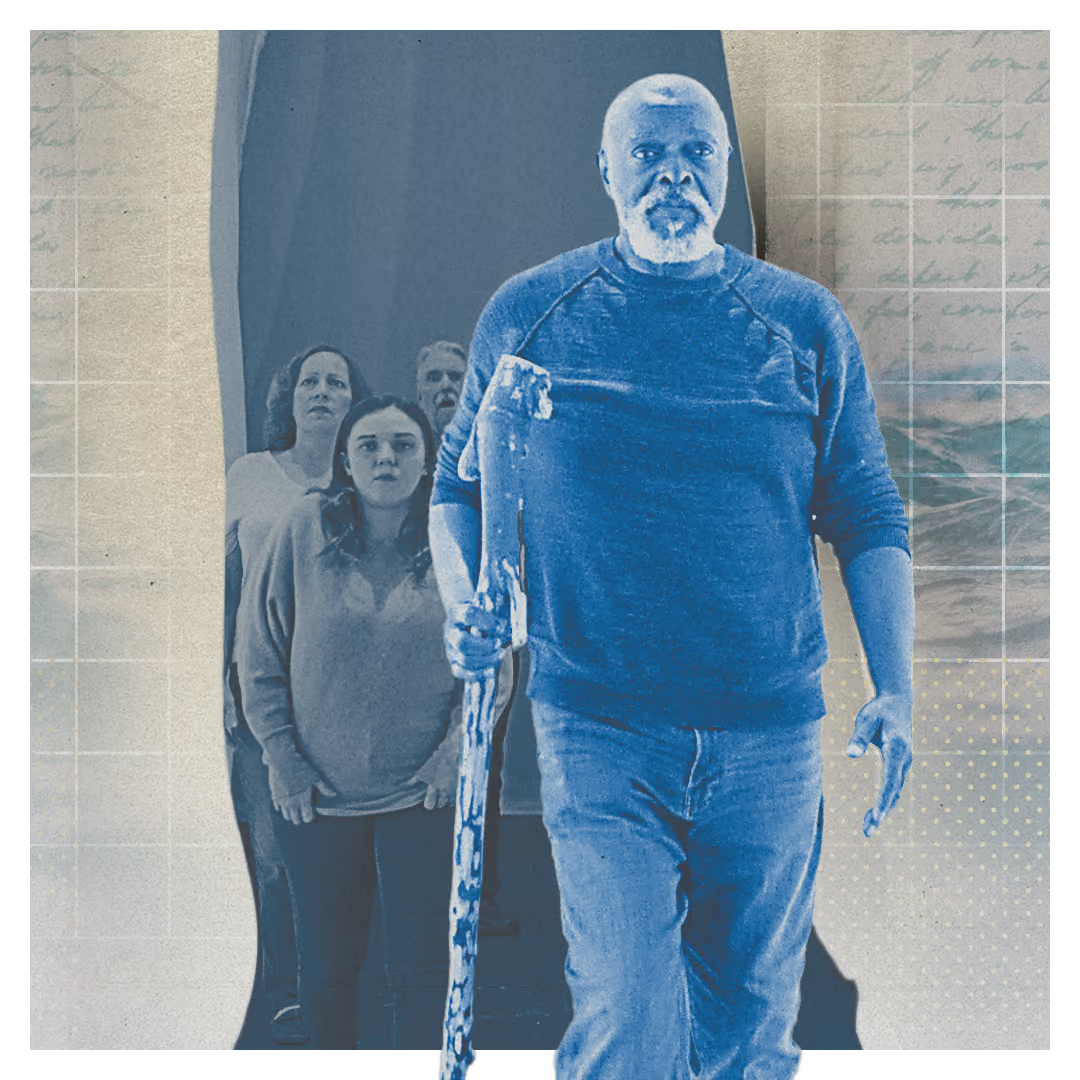
Intro: Welcome to the Spoken Gospel podcast. This is our attempt to speak the gospel out of every corner of scripture. We believe every part of the Bible, Old Testament and New, is about Jesus, and this podcast is our experiment to publicly test that belief. Let's jump in. [upbeat music] Well, hey there, welcome to the Spoken Gospel podcast. Me and Seth are here, and we're excited to talk to you today.
Seth: So excited, and you are a dad in four days.
David: In four days. Oh, my goodness.
Seth: It's almost-
David: It's too much.
Seth: It's so exciting.
David: It's too much. We had our last ultrasound this morning 'cause we go every week for medical reasons, but everything's fine, and four days.
Seth: Four days. David Bowden.
David: Dad.
Seth: Spoken Word Poet.
David: Oh, this is my new Twitter bio? [laughs]
Seth: Yeah, it's gonna be great. It's like, oh, it's like just, it's just a title with a period-
David: Yeah, that's right
Seth: ... and then another title, and it has to start with father-
David: That's right
Seth: ... then husband, and then podcaster.
David: Podcaster. [laughs]
Seth: And then Spoken Word Poet, or whichever one you think-
David: Whichever one is-
Seth: ... most important after the godly ones.
David: Oh, I see, after the godly. [laughs]
Seth: No, no, no, Christian. Christian.
David: Or, or like, or you could be really, like really spiritual, and you'd be like-
Seth: Sinner.
David: Yeah, sinner. [laughs]
Seth: Yeah. [laughs] Sinner, father, husband.
David: I like the ones that don't even say Christian. They're like, "Disciple of, of, of Yeshua."
Seth: Yeah, get, [laughs] they get really intense.
David: Yeah.
Seth: You should get Yeshua in there.
David: Yeshua. [laughs] Or as we like to say, Josh.
Seth: Josh.
David: 'Cause He's like Yeshua.
Seth: Josh on every page.
David: This is, this is our experiment to find Josh in every corner of scripture.
Seth: Yes.
David: Here it is.
Seth: Here he is.
David: So today, uh, sorry for that [laughs] strange introduction, everyone, but, uh, uh, so today we have, uh, a, a really interesting, um, passage we wanna look at. We're, we wanna do a standalone episode because it's, um, it's kind of strange. Um, it, it, it's Exodus-
Seth: Mostly strange-
David: Yeah
Seth: ... because it's just, you, there's not a lot going on.
David: That's true. It seems like there's not a lot going on.
Seth: Seems like there's not a lot going on.
David: But, but like, yeah.
Seth: Jethro is giving leadership advice to Moses.
David: This is Exodus 18.
Seth: Exodus 18.
David: Yeah.
Seth: Jethro, Moses', uh, father-in-law, is giving him leadership advice-
David: Right
Seth: ... on how to govern the people of Israel.
David: Right, and like, I mean, le- I, I've really only ever heard leadership parables drawn out of this text.
Seth: That's, yeah.
David: That's like, that's all I've ever heard is like the, like here's how to, like build a ministry or, or like govern a company. This is how you do it.
Seth: Right. So let's, let's just go over-
David: Okay
Seth: ... the whole text-
David: Yeah
Seth: ... and see, like why do, why is that normally what, all we pull out of this?
David: All right.
Seth: So Jethro, the priest of Midian, so he's a priest, Moses' father-in-law, hears that God's doing great things in Israel, and goes and visits Moses, um, before he gets to Mount Sinai. There's actually some debate on whether or not this is before or after.
David: Before or after.
Seth: Before or after.
David: Right.
Seth: Whatever.
David: We're gonna s- uh, for, for our own argument, we're gonna pres- we're gonna assume that it's before because as John Sailhamer points out, there's no reason-
Seth: Right
David: ... there's no, there's nothing that necessitates us to think that this happened after Mount Sinai.
Seth: That's exactly right. So anyway, he walks up to Moses. Moses walks out of his tent, he's like, "How's it going?" [laughs]
David: "I've heard some things have been happening." [laughs]
Seth: I was just like, what is that conversation like?
David: Oh, my gosh.
Seth: "Yeah, God parted the Red Sea."
David: The Red Sea.
Seth: "Well, what was that like?"
David: "We saw a bunch of locusts." [laughs]
Seth: [laughs] Just, I was just having a lot of fun imagining, like just kinda hearing rumors, "Did God really, like send plagues?"
David: Or like, it's like the, it's like, it's your father-in-law.
Seth: [laughs]
David: And it's like, you guy- we've all had that, that moment when like your father, you sit down with your father-in-law at a family gathering, he's like, "So like, how, how things been going?" And Moses just is like, "Well-"
Seth: Well.
David: "... quite a few things. We just ate bread that we scraped off the ground from the morning dew." [laughs]
Seth: That's just a really-
David: That's a lot of things-
Seth: A lot of things
David: ... to catch him up on.
Seth: And Jethro praises God. Verse nine, "And Jethro rejoices for all the good that the Lord had done to Israel. Blessed be the Lord who delivered you out of the hand of the Egyptians. Now that I know," verse 11, "that the Lord is greater than all gods."
David: Mm.
Seth: And that goes back to what we talked about.
David: Right, this is the whole point, that God did all these things.
Seth: It's like, "I wanna prove that I'm greater than all the other gods."
David: Yes.
Seth: "I wanna prove that I am your savior."
David: That's good.
Seth: So he's like, he's like fulfilling what the purpose of the Lord is.
David: Yeah, yeah, yeah. That's really good.
Seth: So that's good.
David: Yeah, God was like, "I'm gonna do all these acts, and all these great acts of judgment," like he says, I think in chapter five or six. Yeah, and he says that, and, and so that people may know that there's no one like the Lord, and here it is.
Seth: Right.
David: That's exciting.
Seth: And like all in-laws, he stays longer than [laughs] he was expected to, I guess. And so Moses goes to work the next day, and Jethro just kinda watches him as he's at work, and he's- [laughs]
David: I love this picture of like the, like backseat driver father-in-law.
Seth: [laughs]
David: It's so funny. "Oh, that's how you're doing it? Well, I guess."
Seth: So Moses is in court, I guess, and he's sitting down, and all the people of Israel are coming to him with problems and cases that have come from according, and it says verse 18, "When they had, when they had a dispute, they came to me, and I decided between one person another, and I make them know the statutes of God and His laws." First question I had there was like, what laws is he talking about?
David: Right.
Seth: 'Cause we haven't got to the laws yet.
David: Right, which that's why a lot of people think that this is post-Sinai. But we know that there was this like mini version of the covenant given right after they passed the Red Sea, uh, in Exodus 15, and they s- Moses sang his song, then God says, "If you o-"
Seth: Oh, yeah.
David: "If you obey all my statutes and all my commands."
Seth: Remember He said the statutes and rule.
David: Yeah, exactly.
Seth: Yeah. [laughs]
David: So it's like, well, if we obey them, we can be your people, and we'll have this covenant with you.But what are they? We, we don't need to think that, like, every single thing that happened in that moment was written down. We can assume that either God said more there, or that's what Moses is for. Like-
Seth: Yeah
David: ... God has disclosed some of this to Moses, and that's why people are coming to him, because he knows. And so Moses decides disputes between people, and then tells them the laws of the Lord.
Seth: That makes sense. And if he has a special relationship with the Lord, I'm sure that he's in prayer-
David: Right
Seth: ... going to the Lord. It's like he's getting all this information on the fly maybe.
David: Yeah. [laughs]
Seth: Like-
David: Maybe. No, seriously. Yeah, that's right
Seth: ... before it's written, like, concrete down. And one of the great things we'll probably talk about in the next couple weeks is, like, we don't actually have all the laws.
David: That's correct.
Seth: Which we'll probably talk about. Anyway, he's doing this, and Jethro's like, "That's not a great way to run a country." [laughs]
David: Or as he says, "What you're doing is not good." [laughs]
Seth: Just, just like-
David: Well, thanks, Dad.
Seth: Thanks, Dad. Um, and he gives him, he said, "There's a better way to do this." He says, "You are gonna represent the people before..." Uh, sorry, you, uh, he has this better idea, where he's gonna say, "You need to delegate your authority-
David: Right
Seth: ... to peoples of, uh, people of-"
David: Thousands.
Seth: "... hundreds, 50s, and 10s."
David: Hundreds, 50s, and 10s.
Seth: For about an hour, I tried to draw the org chart for all this. [laughs]
David: Oh, you would.
Seth: So I was like, "How does this actually work?"
David: You so would.
Seth: So we, like, there's two million people in Israel roughly.
David: You got a moment, you know, senior youth ministry.
Seth: I was just trying to figure out, like, what would the org chart for this look like?
David: Oh my gosh.
Seth: How many, like, people, how many leaders of thousands would there be if there's two million people? Actually, this organization would've been huge.
David: Oh, yeah.
Seth: So I was like, can it that, like, I was like, I wonder if there's, like, a, a step, like, if there was, like, a step missing. This is just, anyway, I was just-
David: It, is a Fortune 500 company one that has 500 employees?
Seth: I, uh-
David: Is that what that means?
Seth: I think so, at least 500 employees.
David: Yeah, so it's like [laughs] you're talking about, uh, you're talking about, like, all these massive, more than Fortune 500 companies. [laughs] Like-
Seth: Right. Well, and also, like, representatives for a nation, and, like, you know, we don't really know how many Israelites there were, but, like, a million?
David: Yeah, or more.
Seth: Or more.
David: Right.
Seth: And so, I mean, like, that's, like, you have, like, states.
David: Oh, yeah.
Seth: And you have, I mean, there's 12 tribes.
David: Yeah.
Seth: And so, like, even if you divide it perfectly evenly among one million people, that's hundreds of thousands of people.
David: Per tribe.
Seth: Per tribe.
David: Yeah.
Seth: And if there's a leader o- for every thousand of them, it was like you'd have hundreds of thousands of leaders.
David: Oh, yeah.
Seth: So I was trying to figure out, like, there's gotta be, like, a step we're missing. Anyway, that was, that was more technical than it needed to be. And, um, he says the, "These people will bear the burden of leadership with you," verse 23, "And if you do this, God will direct you, and you will be able to endure, and all this people also will go to their place in peace." And Moses listens to his father-in-law. He does what they, what he says he, he's gonna do, and then his father-in-law leaves after giving this advice.
David: Right.
Seth: So really, like, it, what's going on here besides organizational structure?
David: Some kind of, yeah, leadership strategy. What's really happening?
Seth: And so I think what John Sailhamer points out, and which I think is really fascinating, is that Jethro the priest is being set up to be a kind of Melchizedek that happened with Abraham.
David: Which we've met this guy before. This was, this was written by one author, the to- the whole Torah. Uh, people who are reading this part of Exodus, it's assumed that they would already know everything going on in Genesis, where we meet this guy, Melchizedek.
Seth: Right.
David: So it's not crazy to think that, you know, we could build this connection, is what I'm saying.
Seth: No, exactly right. And so Melchized- And so in the, in the text, there's a whole bunch of reasons to see parallels to them.
David: Okay. Let's see 'em.
Seth: Melchizedek is called, uh, the king of Salem, and when they greet one another, they greet each other with Salem. So in that phrase, when we greet one another, the word is Salem.
David: Oh, interesting.
Seth: Um, Abraham has a son named Eliezer, which means God is my help. Moses has a son named Eliezer, which means God is my help.
David: Mm-hmm.
Seth: Moses praises, or Melchizedek praises God for the victory in battle that Abraham has.
David: Oh, yep.
Seth: M- uh, um, um-
David: Jethro
Seth: ... Jethro praises God for the victory that-
David: Everything he did in Egypt
Seth: ... he, he, everything he did in Egypt. Melchizedek brings bread and wine and celebrates the Lord's provision.
David: Oh, yeah.
Seth: Jethro brings burnt offerings to sacrifice to the Lord.
David: Right after a bunch of bread and wine.
Seth: Right after a bunch of bread and wine. [laughs]
David: After the Passover.
Seth: Abraham was told, um, that he would be a sojourner and stranger as part of the covenant.
David: Uh-huh, and he's, and he's Gershom.
Seth: And his, his son is named Gershom. It means, like, I am a s- a stranger in another land.
David: Which is Moses' son, and both of them get an explicit mention in this passage.
Seth: Right.
David: Eliezer and Gershom both get explicit mention and the meaning of their name.
Seth: Right, which-
David: Which seems kind of repetitive
Seth: ... it does, unless you're trying to make connections-
David: Right
Seth: ... in some other part of your work.
David: Right.
Seth: And so he's bringing this back to Melchizedek.
David: Yeah. And, like, names and places, these things in the, um, imagination of an ancient Near Eastern person that would be reading this at the time h- holds a lot more weight than us.
Seth: Right.
David: Like, my name's David. There's so many Davids, and most Davids aren't named David for a reason, you know?
Seth: Yes.
David: Like-
Seth: And even, but even within the structure of the book, what, what's actually happening here? We have Moses, God's divine lawgiver-
David: Mm
Seth: ... and chosen instrument to redeem His people, now receiving advice from his father-in-law?
David: Yeah, and, and, yeah. [laughs]
Seth: On how to instruct and manage the entire nation? Like, this guy needs credentials-
David: Right
Seth: ... in order to, like, justify the type of voice he has in Moses' life.
David: That's true. Every time, every other time that someone brings something to Moses and is like, "Hey, you should do this," like whenever the people come and complain, or Pharaoh tries to change the agreement, and he's like, "Well, okay, yeah, the, just the men can go and worship God," you know, he's like, "Nope, that's not how it's gonna go, 'cause-
Seth: That's right
David: ... Yahweh spoke to me. This is how it's gonna go." But now, all of a sudden, Jethro seems to have this authority. Where's that coming from? [outro music]
Seth: So I think how do we get to Jesus in this text is, like, we actually have a line going from Melchizedek to Jesus.
David: Right, and we learn that-
Seth: In Psalm 110. It's like when, this is a very specific Messianic Psalm that says, "The Lord has sworn and will not change his mind. You, the son of David, are priest forever after the order of Melchizedek."
David: Mm-hmm.
Seth: Super confusing.
David: Right.
Seth: But the Book of Hebrews spends five chapters unpacking what that means and how it can only be fulfilled in Jesus. So what we have here is we have Melchizedek is this type of Jesus bec- why is he a type of Jesus? Because in the narrative, he doesn't have a father or mother, he doesn't have a genealogy connecting him to his family lineage. He just kind of appears-
David: Right
Seth: ... on the scene, and the author of Hebrews says, like, in the same way that the narrative doesn't describe him as having a father or mother, that he's kind of, like, eternal-
David: Uh-huh
Seth: ... we need a priest who is eternal-
David: Yeah
Seth: ... to offer an eternal sacrifice for us.
David: What is narratively true about Melchizedek is actually true about Jesus.
Seth: That's right. And so when you have Melchizedek acting as, like, the precursor, so, and Melchizedek appears right before God gives the covenant to Abraham. Like, he's like the precursor, he's like the, he's, like, greasing the wheels-
David: Yeah [laughs]
Seth: ... for the covenant to be enacted.
David: The pro- the prologue.
Seth: The prologue to the-
David: The covenant
Seth: ... and the, and the same thing happens here with the covenant on Mount Sinai.
David: Mm.
Seth: So what should people who are reading the Torah in their time be expecting of the final Messiah and the final Son of David?
David: Mm.
Seth: They should be expecting a priest to come who ha- whose genealogy doesn't seem to matter, who s- doesn't have a father or mother listed, who kind of comes out and who seems to be this authority without having, like, authority by virtue of who he is, coming, greasing the wheels, and making the covenant possible.
David: Mm.
Seth: Where do we see that?
David: Mm.
Seth: We see that in Jesus.
David: Yeah.
Seth: Jesus is a true and better priest who comes and makes ready his people for the promises and covenant of the Lord. That's, that's where Jesus is here.
David: Yeah. So what does ... I just wanna, like, ask, let's ask this question just so we can kind of put a, a better bow on this thing. Um, what, what, what do we talk about when we say that Jesus is this priest who makes possible a new covenant? What, what does that mean? Um, and let's answer that question, and then let's also answer the question of is there something with the division of the people that is happening? Like, does that mean anything for us in the delegation and everything?
Seth: Oh, yeah, yeah, yeah.
David: Does that mean anything for us, or is it just this Melchizedek precursor?
Seth: Well, let's talk about the easy one-
David: Right
Seth: ... which is, like, the division of the people.
David: Oh, okay, that's the easy one. [laughs]
Seth: Oh, yeah, I was gonna say, the division, I mean, like, the division of the people, like, one, there's, you need to use wisdom in organizing the people of the Lord. I feel like that-
David: Mm
Seth: ... that's, I mean, that's, that's not wrong to take a practical application from this, but I-
David: No, so I, when I was reading it, I, I kind of had a different thought. I, I was, I was thinking that, um, you know, so i- i- everyone had to come to Moses to get, uh, like to decide disputes, and to, like, know the, the laws and statutes of the Lord. They had to come to him, and, and, you know, like we've looked at, uh, Jethro comes to him, he's like, "That's gonna wear you out, so, you know, s- make these little microcosms and these tiny little organizational structures, and set leaders up."
Seth: Mm.
David: "And make sure those leaders are people that are above reproach, that aren't easily taken by a bribe." He sets all these qualifications for these leaders for them, and, and then they will be able to decide those smaller disputes for those smaller groups of people. And what's interesting is, um, uh, I, I'm just thinking of, like, some of the promises that come soon, uh, in the, in the prophets, where, where we're gonna read about, like, there's coming a time when, um, a man will not need to s- say to his neighbor, "Know the Lord," but the law will be written on their hearts.
Seth: Yeah.
David: We don't need a mediator anymore. We don't have to go to someone else, and someone's above us, and there's always this chain of command separating us. 'Cause, 'cause now it was like-
Seth: Right
David: ... it was like I can go straight to Moses, and then Moses goes straight to God.
Seth: Yeah.
David: And now it's like more division.
Seth: Mm.
David: There's more stratifications to work through to get to Yahweh, and what, and, and His presence, and what He directly wants.
Seth: Yeah.
David: There's like a dilution of that ordinance, and that law, and that presence, and now he's say, like, what we know in Christ is the Holy Spirit comes and He writes the law on our hearts. We don't have to go to anyone. We get straight access to God with- through the one mediator of Jesus Christ.
Seth: That's good.
David: I think that's cool.
Seth: I was, I also thought the exact opposite.
David: [laughs]
Seth: I was thinking, I was like, what, so he, um, Jethro defines, um, Moses' role as, "You shall represent the people before God and bring their cases to God." And then what he does is he takes that representative role, and he gives it to more people.
David: Mm-hmm.
Seth: So what is he doing? He's multiplying the number of priests in the Kingdom of Israel, and so one of the promises that we see in the Old Testament is that God is gonna make His nation a na- a kingdom of-
David: A kingdom of priests
Seth: ... of priests.
David: Which he says in chapter 19 next.
Seth: Right.
David: Yeah.
Seth: Yeah, so, like, so a- and it's actually the same point, just making it-
David: A different way
Seth: ... just, just a different way.
David: Yes.
Seth: Like, actually, so yeah, there's all these, now you have to go through a chain of command-
David: Right
Seth: ... to get to the Lord. But actually, the Lord is coming through the chain of command as well.
David: Yes.
Seth: And one day, everyone will be priests. [laughs]
David: Yes. So now it's not just, um, now it's not, okay, make leaders over thousands, and hundreds, and fifties, and tens, right? Now it's I've made ones. [laughs]
Seth: Right.
David: Which is every single one is a priest.
Seth: Yeah.
David: Right? Because you have-
Seth: By virtue of the one priest-
David: Of the one priest, Jesus Christ-
Seth: ... Jesus living inside
David: ... inside of you-
Seth: Yeah
David: ... He has qualified you, just as Moses was qualified, to go out and bring His laws and His statutes, His presence, His, His judgments, His wisdom out to the world. And there, we don't need a chain of command in order to do that.
Seth: Right.
David: We've been given that authority in Christ. You know, "All authority in heaven and Earth has been given to me. Now I give it to you, and go, do it." So yeah, same point, different directions.
Seth: Yeah.
David: That's pretty cool.
Seth: I like that.
David: I like that, too. So let's, let's go back, and let's answer the question about y- y- you talked about Jesus is this priest forever in the line of Melchizedek. L- I just gotta, I wanna repeat back kinda what you said, 'cause it's, it's, it's a lot. So Abraham-Um, is about to get the covenant of God in, in Genesis like 16. It's gonna get reaffirmed. Um, and, and before that, he gets, he, he, he's met by Melchizedek, who's this seemingly eternal priest, because in Genesis, there's, there's no birthday or father or mother or anything like that. Um, pretty much everybody else listed in Genesis, you get when they died and how long they lived and all that kind of stuff. You don't get that with Melchizedek. He comes out of nowhere, and he's the precursor to this covenant that's gonna be made. And then we get to Exodus, and all this tension has been building around Israel coming to Sinai. They're gonna go there, they're gonna worship God, something big's gonna happen, and what do we get right before? It's like, interrupt the narrative, screeching halt, we're almost there, and then the father-in-law comes in, and he's this priest from Midian, and, um, you have all these same elements that were in the Melchizedek story, and it's like, oh, what's happening again? Oh, it's a precursor to a covenant. And then what you're saying is, let's trace this line. The, the, the real priest, the newer and better, uh, priest from the line of Melchizedek, who's not narratively eternal, he's actually eternal, uh, we know this from Psalm 110, and we know this from Hebrews, is Jesus Christ. He has come, and he has, he is the precursor, the enactor, the one who makes possible the covenant, because he is our eternal priest. That's what you've said.
Seth: Eternal wheel greaser.
David: Okay, so the eternal wheel greaser, Jesus. So what does it mean, what's Jesus' priestly role? Like, like, what does that mean for us? Why is that important?
Seth: Jesus' priestly role means that he is able to offer sacrifices for our sin and be able to bring us into the Lord's presence. The problem with the Old Testament priests and the Old Testament sacrifice, not so much a problem, but just the nature-
David: Right
Seth: ... of the role is that it was always temporary.
David: Right.
Seth: It was always-
David: The priest had to stand every day in the, in the tabernacle making sacrifices over and over.
Seth: Not only for the whole nation, but for themselves.
David: For themselves, because they were sinful.
Seth: Because, like, there's just a never-ending strain of sacrifices. And even the most, the most upright priests would have a sacrifice on the day of his death.
David: Yeah.
Seth: Because, like, it, the, the work would never be done.
David: Mm.
Seth: So when you have Jesus as the better Melchizedek-
David: Mm-hmm
Seth: ... and the better Jethro-
David: Mm
Seth: ... he comes as the one who can offer a sacrifice by virtue not only of his indestructible life-
David: Mm
Seth: ... so it's an eternal sacrifice, but also by virtue of his sinlessness. He was never sacrificing for himself, not even on the day of his death. He was sacrificing perfectly for all people for all time.
David: Yeah.
Seth: So the way that Jesus is able to grease the wheels for a new and better covenant is that, one, he's able, if, if Jesus is truly that better priest and also the better sacrifice on the cross, his priesthood extends throughout eternity and for all time because he is eternal himself. And the sufficiency of his sacrifice, like the power of his sacrifice, comes from the fact that he was sinless. He was actually-
David: Right
Seth: ... a perfect lamb, and lambs can't take away the blood of humans, uh, the sin of humans.
David: Right.
Seth: 'Cause, like, humans are more valuable-
David: Yes
Seth: ... than, [laughs] than lambs.
David: Right.
Seth: So Jesus comes as the most valuable possible sacrifice-
David: Mm
Seth: ... and offers himself sinlessly so that when the new covenant is enacted, what happens? We not only are freed from the condemnation of sin, from the shame of sin, but we're also given the title of priest ourselves.
David: Wow, yeah.
Seth: The one that, the, the role that had to be, like, disseminated out-
David: Right
Seth: ... and delegated and have all these structures and systems is actually done away with.
David: Mm.
Seth: The veil is torn in two.
David: Yep.
Seth: And we have access to the Father, to the Lord, by virtue of Jesus's-
David: Yeah
Seth: ... priesthood.
David: And now as many priests, we go out and we say, "Be reconciled to God."
Seth: Right.
David: As 2 Corinthians says, right? Yeah.
Seth: Now, that's just, so we should just, that's not light reading or thinking.
David: No.
Seth: We actually have a text in Scripture about this, and it says, "And about this we have much more to say, and it is hard to explain," Hebrews 5:11. So-
David: Yeah
Seth: ... if you're wondering, you could say a lot more. We probably won't.
David: We probably won't, but we could.
Seth: It's also very hard. [laughs]
David: It is hard. So yeah, if you're sitting here going like, "Oh, that was a lot," so is the author of Hebrews who's trying to explain all this, too. It's a lot.
Seth: It's a lot.
David: And that's okay.
Seth: And if you have questions, you should send them to us.
David: Yeah, you, you should. Yeah, you can send it to, uh, [email protected], and we'd love to hear from you. Uh, I wanna make one final little, as you were talking, I was like, I wonder if all those little, um, literary clues that, uh, Exodus is giving us with Jethro to throw us back to Melchizedek, if, are any of those present in the gospel narratives? I was like, that's an interesting question I hadn't thought of till now. But I, I thought, okay, well, the bread and wine-
Seth: Yeah
David: ... that Melchizedek brings, that's the Passover that Jesus celebrates bef- and says, "This is the covenant. The new covenant is here."
Seth: Right.
David: So it's like, oh, I'm the new, I'm the new Melchizedek, you know?
Seth: Right.
David: And then there's also, um, before they go out, I think it's in John's account, we're told that they sing, they worship, just as Melchizedek did-
Seth: Oh, yeah
David: ... and Jethro did.
Seth: How about in the, in the upper room?
David: Which is interesting. Yeah, in the upper room.
Seth: Yeah.
David: And, um, there's a sacrifice and an offering made-
Seth: Right
David: ... in Melchizedek's and in Jethro's, but that is, well, where's that in the story?
Seth: Jesus. [laughs]
David: It's Jesus. He's, he's, he's sitting there, the living sacrifice, Jesus, is there.
Seth: Yeah.
David: So I do think that it's quite possible all the elements that we've pointed out here in the Melchizedek story and the Jethro story as the precursor, the, the wheel greaser to the covenant, is found also in the gospel narratives themselves, which is pretty cool.
Seth: God, God is my help. That's the name of Eliezer, like, God is my help.
David: Mm.
Seth: And what's, what's the one thing the L- Jesus cries out? "My God, my God, why have you forsaken me?"
David: Mm.
Seth: Like, it's, it's the anti-type of what the hope was in Eliezer. So, like, when the, how does the Lord help? Like, through Jesus' own death.
David: Mm.
Seth: Anyway, I'm just thinking about that.
David: Yeah, that's good.
Seth: I was wondering if there's another way to, you know.
David: I'm sure there's lots. And yeah, and if you're, and if you're wondering also, like, are we u- are we leaning too heavily on Psalm 110 to make this jump into the New Testament? No, [laughs] because it's the most quoted Psalm in the New Testament, Psalm 110 is. It's, go read it after this podcast-
Seth: Yeah
David: ... and you'll be like, "Oh, I've heard that before."
Seth: Matthew 24, Mark 12.
David: Uh, Acts 2.
Seth: Acts 2.
David: Yep.
Seth: Hebrews 4 through 8.
David: Yep, it's everywhere in the New Testament.
Seth: Yeah.
David: And so, yeah, so this has been cool. I was, I was kind of like, I was like, uh, this'll probably be a small special episode. It'll be 10 minutes, and I wasn't super excited about it, and then-
Seth: You weren't excited about Jesus on every page of Scripture? [laughs]
David: Hey, hey, hey. No, I wasn't excited about Melchizedek and Jethro.
Seth: This is a podcast, man.
David: But then you start talking about it, and I got all hyped up, and now this is, uh, this is great. This is a full episode, so this is awesome. Thank you, Seth, for awakening my affections today with Exodus 18. I hope it went that way for everyone else, too.
Seth: Have a great week.
David: Have a great week, everyone. [outro music]
Outro: Thank you for listening to the Spoken Gospel podcast. Spoken Gospel is a nonprofit organization dedicated to creating gospel-centered media that speaks the gospel out of every corner of Scripture in every corner of the world. To learn more about the ministry of Spoken Gospel and view more of our resources, visit spokengospel.com. [outro music]